QUICK SUMMARY
Lean body mass is your weight minus fat. If you know your body fat percentage, subtract it. If you only know height and weight, use a formula: Boer, James, Hume or Janmahasatian. They disagree by up to 5 kg for the same person, and against DEXA scans they can miss by many kilograms.
Lean Body Mass Calculator
If you already know your body fat percentage, our FFMI calculator gives your lean mass directly, along with FFMI and normalized FFMI.
Two Ways to Calculate Lean Body Mass
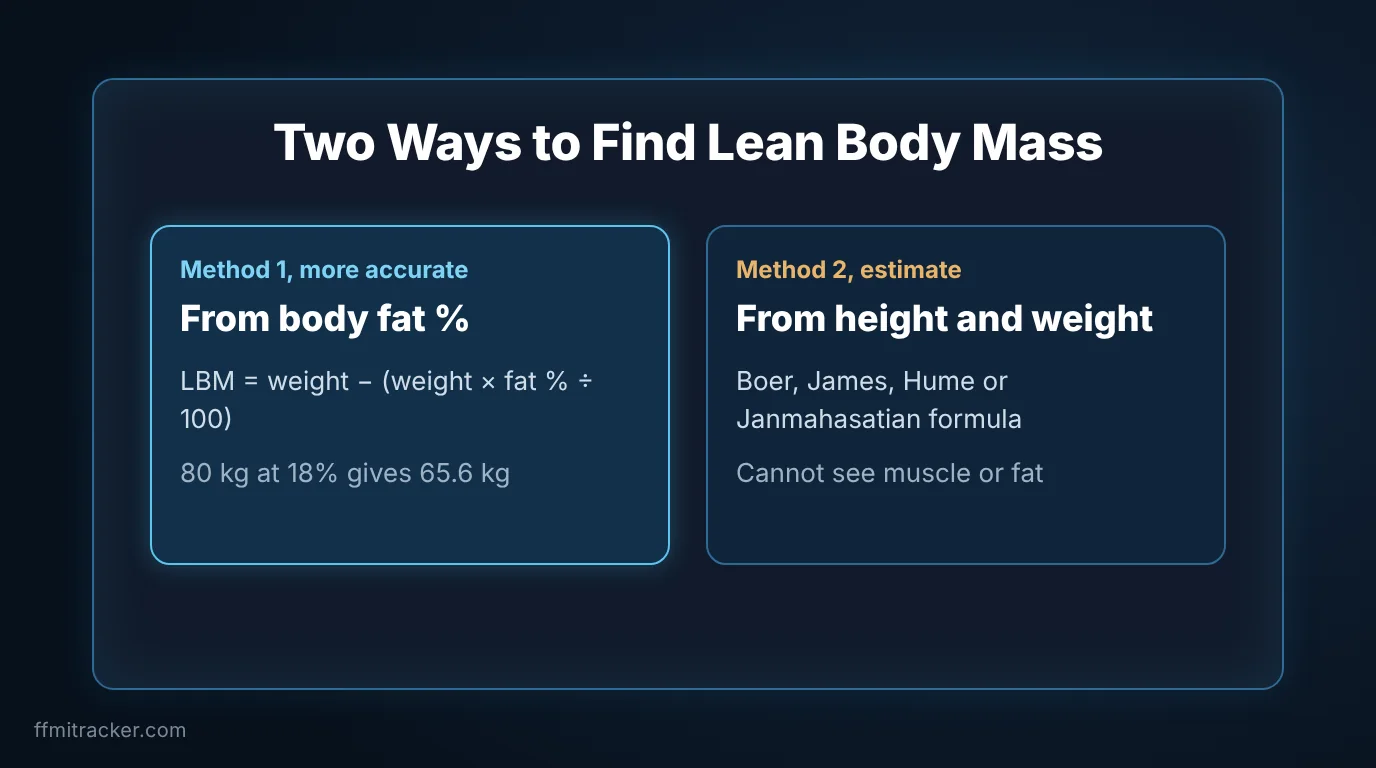
There are two routes, and they give different levels of accuracy.
Method 1: from body fat percentage (more accurate). You need your weight and a body fat figure from a scale, calipers or a DEXA scan.
Lean body mass = body weight − (body weight × body fat % ÷ 100)
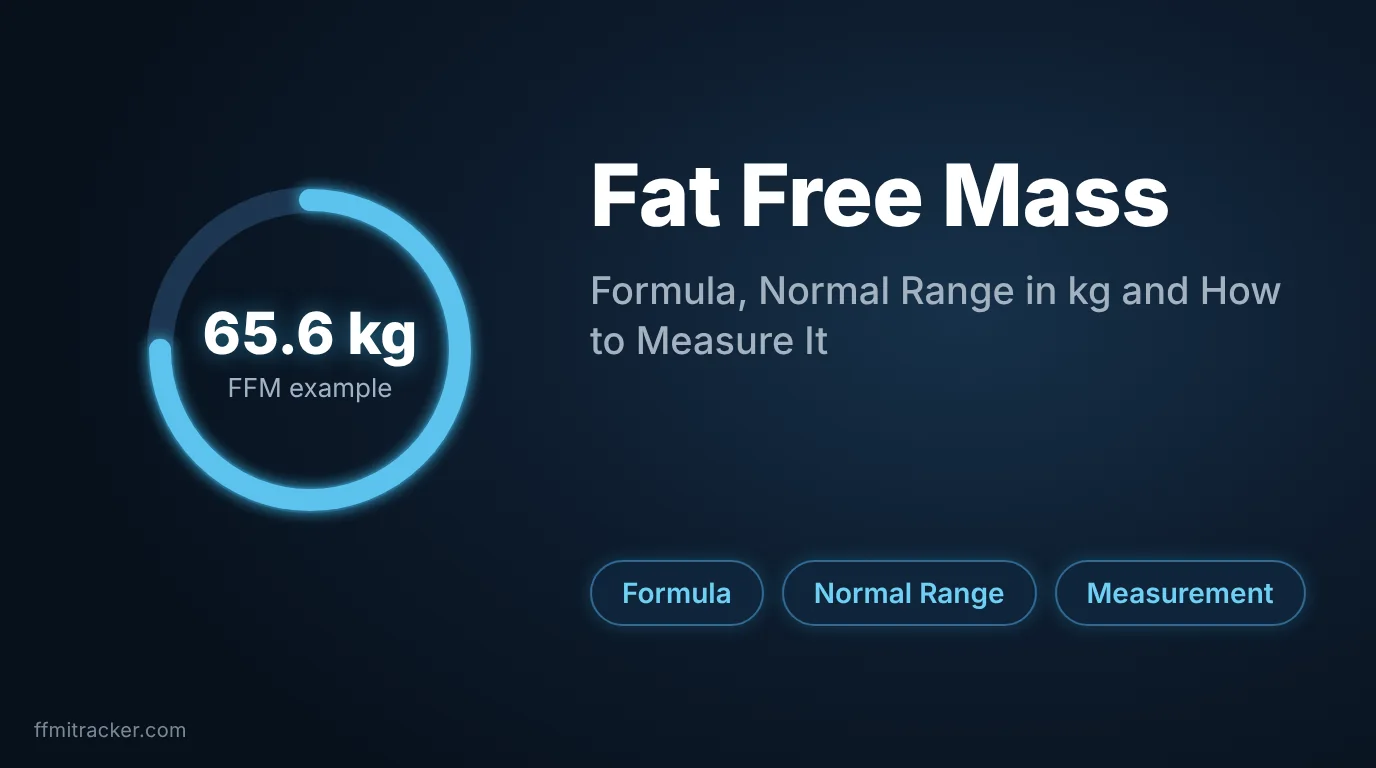
An 80 kg man at 18% body fat has 14.4 kg of fat, so his lean body mass is 65.6 kg. A 62 kg woman at 25% has 15.5 kg of fat and 46.5 kg of lean body mass.
Method 2: from height and weight (estimate). Use a formula. It needs no body fat figure, which is why almost every online lean body mass calculator uses it, but it cannot see how much muscle or fat you actually carry.
The Four Lean Body Mass Formulas
Weight (W) is in kilograms and height (H) is in centimeters.
Formula | Men | Women |
|---|---|---|
Boer (1984) | 0.407 × W + 0.267 × H − 19.2 | 0.252 × W + 0.473 × H − 48.3 |
James | 1.10 × W − 128 × (W ÷ H)² | 1.07 × W − 148 × (W ÷ H)² |
Hume (1966) | 0.3281 × W + 0.33929 × H − 29.5336 | 0.29569 × W + 0.41813 × H − 43.2933 |
Janmahasatian (2005) | 9270 × W ÷ (6680 + 216 × BMI) | 9270 × W ÷ (8780 + 244 × BMI) |
BMI here is weight in kilograms divided by height in meters squared. Hume’s formula was built from 29 men and 27 women whose lean mass was measured by total body water. Janmahasatian’s was designed to work across a wide range of body sizes, with weights from 40.7 to 216.5 kg in the development data.
Worked Examples
We calculated each formula for six people, and compare them with the direct body fat method where we have a body fat figure.
Person | Boer | James | Hume | Janmahasatian |
|---|---|---|---|---|
Man, 70 kg, 175 cm | 56.0 kg | 56.5 kg | 52.8 kg | 55.9 kg |
Man, 80 kg, 180 cm | 61.4 kg | 62.7 kg | 57.8 kg | 61.7 kg |
Man, 100 kg, 185 cm | 70.9 kg | 72.6 kg | 66.0 kg | 71.4 kg |
Woman, 55 kg, 160 cm | 41.2 kg | 41.4 kg | 39.9 kg | 36.4 kg |
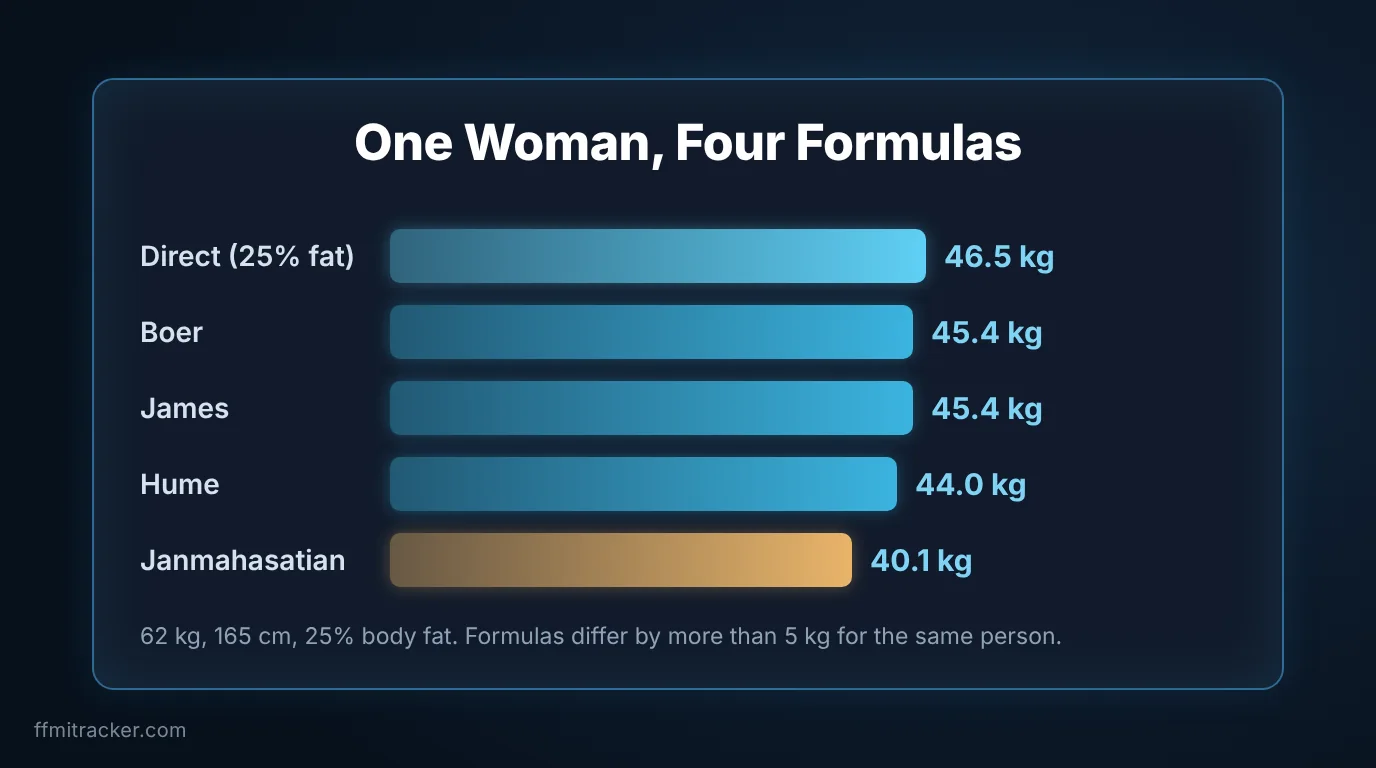
Woman, 62 kg, 165 cm | 45.4 kg | 45.4 kg | 44.0 kg | 40.1 kg |
Woman, 85 kg, 168 cm | 52.6 kg | 53.1 kg | 52.1 kg | 48.9 kg |
Three things stand out.
- The formulas disagree. For the 62 kg woman, the answers run from 40.1 to 45.4 kg, a gap of more than 5 kg. For the 80 kg man, Hume is 4.9 kg below James.
- Janmahasatian gives lower results for women than the other three, and Hume is lowest for men.
- Formulas know nothing about muscle. The 80 kg man at 18% body fat has a direct lean mass of 65.6 kg. Every formula puts him between 57.8 and 62.7 kg. If he trains, a formula will understate his lean mass by 3 to 8 kg.
How Accurate Are These Formulas?
Not very, for any single person. Puri and Blake (2022) compared ten lean body mass equations against DEXA scans in 747 men and 811 women aged 60 to 65. Gallagher’s equation did best in men and Janmahasatian’s did best in women. In the pooled data, Janmahasatian’s equation performed slightly better than Gallagher’s. The average errors were small, around 1 to 2.4 kg, but the 95% limits of agreement were about 11 to 13 kg. That means any one person’s estimate can miss the DEXA result by many kilograms.
These findings come from adults aged 60 to 65, so they may not carry over to young lifters. The practical lesson is the same everywhere: use a lean body mass calculator built on these formulas to estimate group averages or doses, not to track your own progress.
Which Formula Should You Use?
Situation | Better choice |
|---|---|
You know your body fat percentage | Direct method, not a formula |
Women, general estimate | Janmahasatian, per the 2022 DEXA comparison |
Men, general estimate | Boer or James, which are close to each other |
You lift weights and want to track progress | Direct method with the same body fat measure each time |
Medical dosing or imaging | Whatever your clinic specifies |
Lean body weight is used in medicine to scale some drug doses, and in PET imaging to normalize uptake values, which is why some formulas were developed by pharmacologists and not fitness researchers. If a clinic gives you a lean body weight, use their number.
Lean Body Mass vs Fat Free Mass
Calculators and papers use the two names almost interchangeably. A 2024 review in Advances in Nutrition argued they describe the same chemical component and recommended the term fat free mass. For a full explanation, including normal values in kg by height, see our guide on fat free mass.
What Is a Good Lean Body Mass Percentage?
Lean body mass percentage is 100 minus your body fat percentage. In the Swiss adult sample of Schutz, Kyle and Pichard (2002), young adults had a median fat free mass of roughly 82% of body weight in men and 74% in women. Our own conversion from their fat mass index figures gives those numbers, so treat them as a rough guide.
Frequently Asked Questions
These are the questions people ask most often about this topic, with a short answer first.
What is a normal lean body mass?
It depends on height and sex. In a large Swiss sample, typical young adults carried about 58 kg at 1.75 m for men, and about 42 kg at 1.65 m for women. Athletes and lifters sit above these averages. Check the height table in our fat free mass guide to find your own row.
Is 75% lean body mass good?
A lean body mass of 75% means 25% body fat. That is close to the typical level for young women in a large Swiss sample, and below the typical level for young men. Higher is not automatically healthier, and it depends on your sex and age.
Is 90% lean body mass good?
A lean body mass of 90% means 10% body fat. That is very lean and hard for most people to sustain. It sits well above the typical medians for both sexes, so it is not a target for everyone. Talk to a doctor before aiming for it.
How do you calculate lean body mass?
Subtract your fat mass from your body weight. Fat mass is weight times body fat percentage. If you only know height and weight, use the Boer, James, Hume or Janmahasatian formulas, but expect an estimate that can differ from a DEXA scan by many kilograms.
Which lean body mass formula is the most accurate?
In a 2022 comparison with DEXA in adults aged 60 to 65, Gallagher’s and Janmahasatian’s equations did best, and Janmahasatian was best in women. No formula is accurate for every person. The direct body fat method is better when you have a good body fat figure.
Is lean body mass the same as muscle mass?
No. Lean body mass includes muscle, but also bone, organs, skin, connective tissue and body water. Skeletal muscle is only part of it. A high lean mass can come from a large frame or extra water, so it is not a pure muscle score.
The Bottom Line
Use your body fat percentage if you have it, because the direct method beats every formula. If not, pick a formula, but remember the answers can differ by 5 kg between formulas and by more against a DEXA scan. Choose one method, use it the same way each time, and judge changes over months.
This article is for education and is not medical advice. Do not use a calculator result for drug dosing. Ask your clinician.
References and Sources
- Puri T, Blake GM. Comparison of ten predictive equations for estimating lean body mass with dual energy X ray absorptiometry in older patients. British Journal of Radiology. 2022;95(1133):20210378. Source
- Yu S, Visvanathan T, Field J, et al. Lean body mass: the development and validation of prediction equations in healthy adults. BMC Pharmacology and Toxicology. 2013;14:53. Source
- Janmahasatian S, Duffull SB, Ash S, Ward LC, Byrne NM, Green B. Quantification of lean bodyweight. Clinical Pharmacokinetics. 2005;44(10):1051-1065. PMID 16176118. Source
- Boer P. Estimated lean body mass as an index for normalization of body fluid volumes in humans. American Journal of Physiology. 1984;247(4 Pt 2):F632-F636. PMID 6496691. Source
- Hume R. Prediction of lean body mass from height and weight. Journal of Clinical Pathology. 1966;19(4):389-391. PMID 5929341. Source
- Heymsfield SB, Brown J, Ramirez S, Prado CM, Tinsley GM, Gonzalez MC. Are lean body mass and fat free mass the same or different body components? A critical perspective. Advances in Nutrition. 2024;15(12):100335. PMID 39510253. Source
- Schutz Y, Kyle UUG, Pichard C. Fat free mass index and fat mass index percentiles in Caucasians aged 18 to 98 years. International Journal of Obesity. 2002;26(7):953-960. PMID 12080449. Source