QUICK SUMMARY
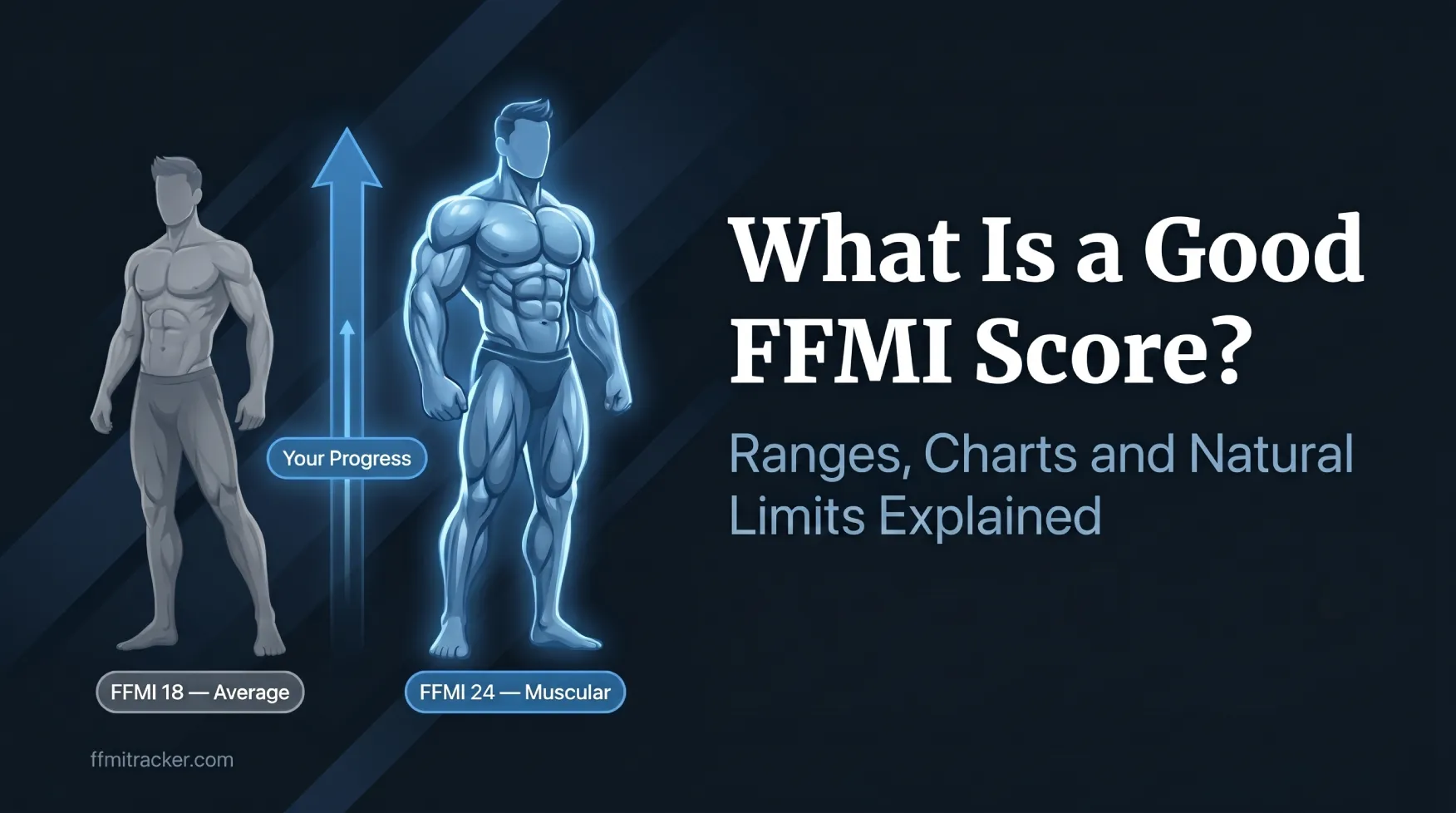
A good FFMI score for an active woman is 17 to 19. The average untrained adult female falls between 14 and 16. Elite natural female competitors typically peak between 20 and 22. These ranges come from female specific data, not male bodybuilding research.
You calculated your FFMI score. Now you are staring at a number and wondering if it is good or not.
That is the most common question after someone uses an FFMI calculator for the first time. The number alone means nothing without context. A score of 20 might be excellent for one person and barely average for another, depending on sex, training history, and goals.
This page gives you that context. Everything here is built around female specific data, not numbers borrowed from male bodybuilding research.
What Is FFMI and Why Do Women Score Differently?
FFMI stands for Fat-Free Mass Index. It measures how much lean muscle you carry relative to your height, with body fat completely removed from the equation. That is what makes it more useful than BMI for anyone who lifts weights.
The formula is simple: FFMI = Lean Body Mass (kg) / Height (m²)
Here is what most websites skip: the original research behind FFMI was done almost entirely on male bodybuilders. The 1995 Kouri et al. paper published in the Clinical Journal of Sport Medicine, which set the natural ceiling at 25, used a sample of 83 men. Women were barely represented.
That matters because biology is different. Estrogen reduces the anabolic response to training. Women have smaller muscle fiber cross sections on average. So when you look at an FFMI chart and see scores like 22, 23, 24 labeled as “natural” or “advanced,” those numbers were written for men. A woman with an FFMI of 19 may be in genuinely elite condition. She just needs a chart built for her.
What Is a Good FFMI Score for a Woman?
A good FFMI score for an active woman is between 17 and 19. The average non training adult female falls between 14 and 16. Elite natural female competitors typically peak between 20 and 22. These ranges come from female specific normative data, not male bodybuilding research.
Female FFMI Score Ranges
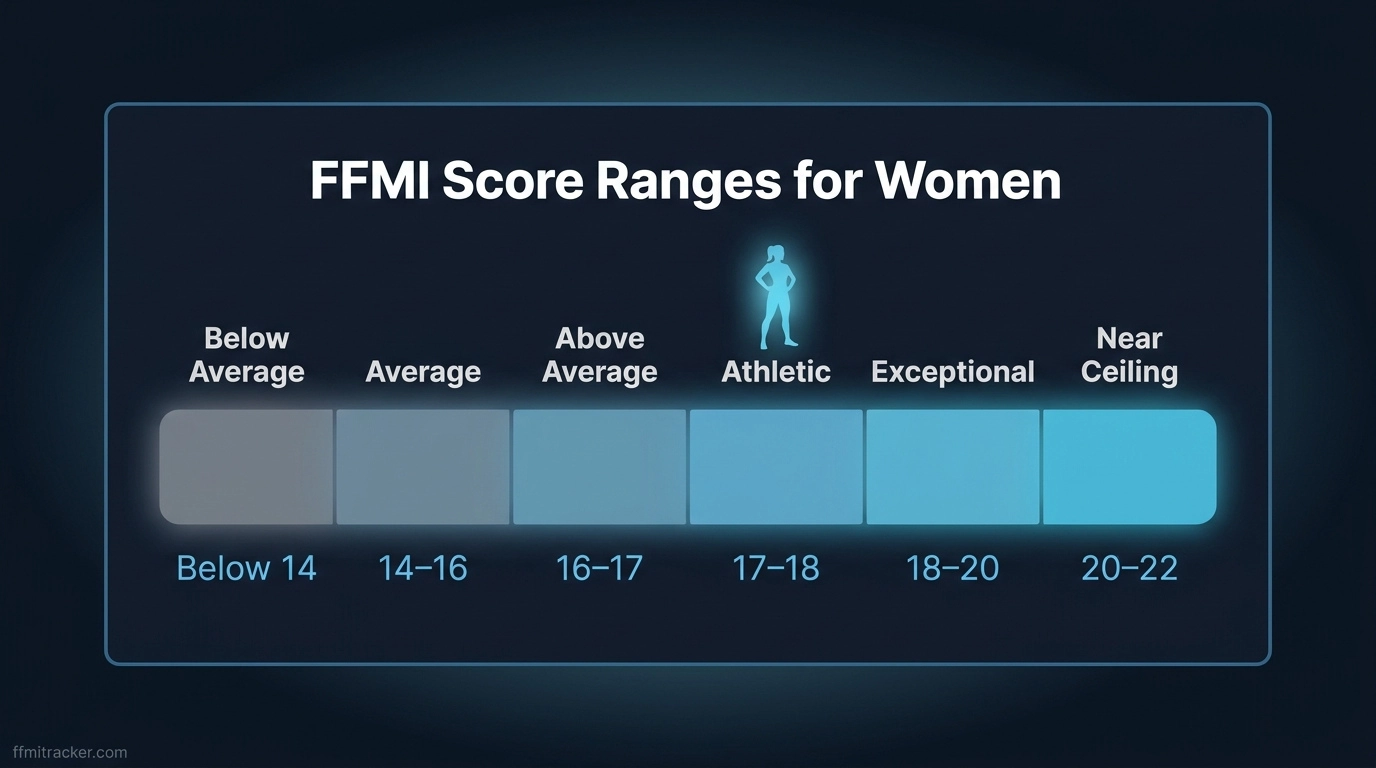
A 2019 study in the International Journal of Exercise Science (PMID 30893018) measured FFMI across a diverse female sample. The mean was 16.9 kg/m² with a standard deviation of 1.7. That is the most reliable published baseline we have for adult women.
Here is the full range chart:
| FFMI Range | Category | What It Reflects |
|---|---|---|
| Below 14 | Below average | Minimal muscle, sedentary lifestyle |
| 14 to 16 | Average | General population, little or no structured training |
| 16 to 17 | Above average | Some regular exercise, visible tone starting to show |
| 17 to 18 | Athletic | Consistent resistance training, noticeable definition |
| 18 to 20 | Very athletic | 2 or more years of serious lifting, strong physique |
| 20 to 21 | Exceptional | Advanced female athlete or competitive physique |
| 21 to 22 | Near natural ceiling | Elite natural competitors |
| Above 22 | Exceeds typical natural range | Rare; worth scrutinizing |
One thing worth saying clearly: a woman with an FFMI of 18 is in better shape, in terms of muscle development, than most untrained men at the same score. The number does not translate across sexes.
What Does My FFMI Number Actually Mean?
Your FFMI number means different things depending on where you fall. Here is what each range actually reflects for women who train.
FFMI Score of 15 (Average Range)
A score of 15 is solidly in the average range for adult women. If you do not follow a structured training program, 15 is a normal, healthy number. It does not mean you are out of shape. It means your body carries a typical amount of lean tissue for a non training adult female.
FFMI Score of 17 (Above Average)
At 17 you are above the population average. This typically reflects someone who works out regularly, maybe a few resistance sessions or cardio with weights per week. Some definition is visible, especially in the arms and legs.
FFMI Score of 18 to 20 (Athletic Range)
This is the athletic range. Most women who have trained seriously for one to two years and paid attention to protein land here. People would describe your physique as visibly fit and muscular, though not extreme.
A score of 20 takes years. You are likely in the top 5 to 10 percent of women who train. This is competition territory. Getting here requires consistent progressive overload, dialed in nutrition, and prioritizing recovery.
What Is the Natural FFMI Limit for Women?
The natural FFMI ceiling for most drug free women is around 21 to 22. This is based on data from natural drug tested federations including the INBA and WNBF, where elite competitors rarely exceed a normalized FFMI of 22.
This is less settled than the male version. The Kouri 1995 paper gave men a clear ceiling of 25. For the full male picture, see our guide on what is a good FFMI score. For women, no equivalent large scale study exists. What we have instead is competition data and the normative study referenced above.
The 2019 PubMed study (PMID 30893018) found that across a range of female athletes including recreational lifters, mean FFMI was 16.9. Cross country runners in that group averaged around 15.3, not because they were weak, but because endurance work does not build maximum lean mass the way strength training does.
If a woman is claiming a natural FFMI above 23, that is not impossible, but it is rare enough to ask questions. The genetic ceiling exists. Very few people reach it without pharmaceutical help, male or female.
How Does FFMI Change by Age for Women?
Most articles on FFMI ignore age entirely. That is a gap, because the hormonal environment changes a lot across a woman’s life.
Women in Their 20s
Your 20s are your best window for building lean mass. Estrogen is at its highest, recovery is fast, and your body responds well to progressive overload. A motivated, well trained woman in her mid-20s can realistically reach FFMI 18 to 19 within two to three years of focused work.
Women in Their 30s
Muscle building slows slightly but does not stop. Many women find their 30s are actually their most effective training decade because they are more consistent, their form is better, and they understand nutrition. Reaching or holding FFMI 17 to 19 is very realistic. Recovery takes a bit longer.
Women in Their 40s and Beyond
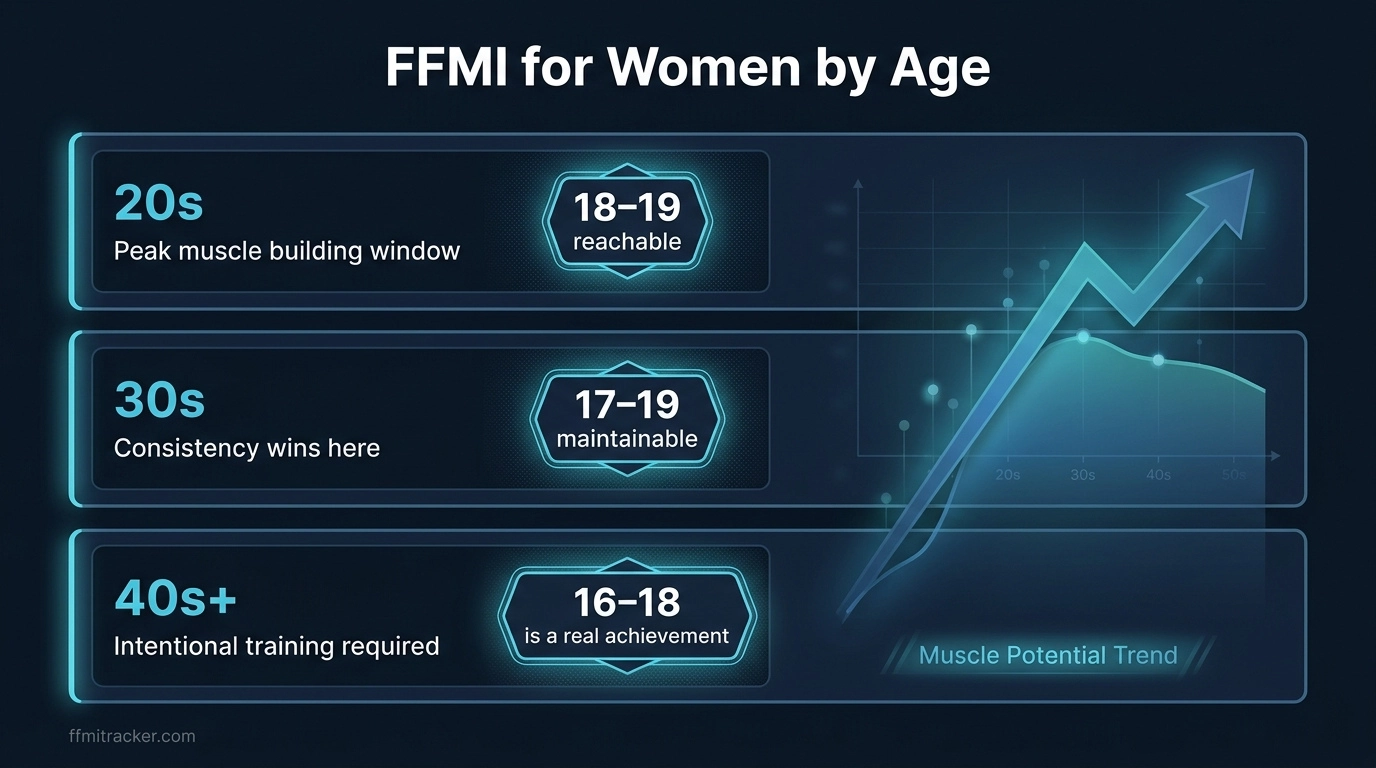
After 40, estrogen begins to decline. Around perimenopause and menopause this accelerates, and muscle protein synthesis drops noticeably. This does not mean you cannot build muscle. It means you have to be more deliberate. Higher protein intake (1.6 to 2g per kg of body weight), resistance training at least three times per week, and seven to nine hours of sleep matter more now than they did at 25. Maintaining FFMI between 16 and 18 past 45 is a real achievement.
How Can a Woman Improve Her FFMI?
Improving your FFMI means increasing lean mass, reducing fat, or both. Here is what the research actually supports.
Train with Progressive Overload
This is the most important driver of muscle growth, backed by decades of evidence. Consistently make your sessions harder over time, whether through more weight, more reps, or less rest. Three to four resistance sessions per week is enough for most women to see steady progress. You do not need to be in the gym six days a week.
Eat Enough Protein
Most women undereat protein. The current research consensus, including the International Society of Sports Nutrition position stand, recommends 1.6 to 2.2 grams per kilogram of body weight per day for people trying to build or maintain lean mass. If you weigh 60 kg, that is 96 to 132 grams daily. Spread it across meals. Good sources include eggs, chicken, Greek yogurt, cottage cheese, and legumes.
Stop Letting the Scale Make Decisions
Body recomposition, gaining muscle while losing fat at the same time, is real. The scale often stays flat or goes up during this process because muscle is denser than fat. FFMI captures what the scale misses. A woman who weighs the same as a year ago but dropped from 28 percent body fat to 22 percent while adding lean mass has made genuine progress. The scale just does not show it.
Protect Your Sleep
Muscle is built during recovery, not during training. Poor sleep raises cortisol, which works directly against muscle retention. If you sleep five hours a night and wonder why your FFMI is not moving, that is likely a large part of the answer. Seven to nine hours is the target.
How Do You Calculate FFMI as a Woman?
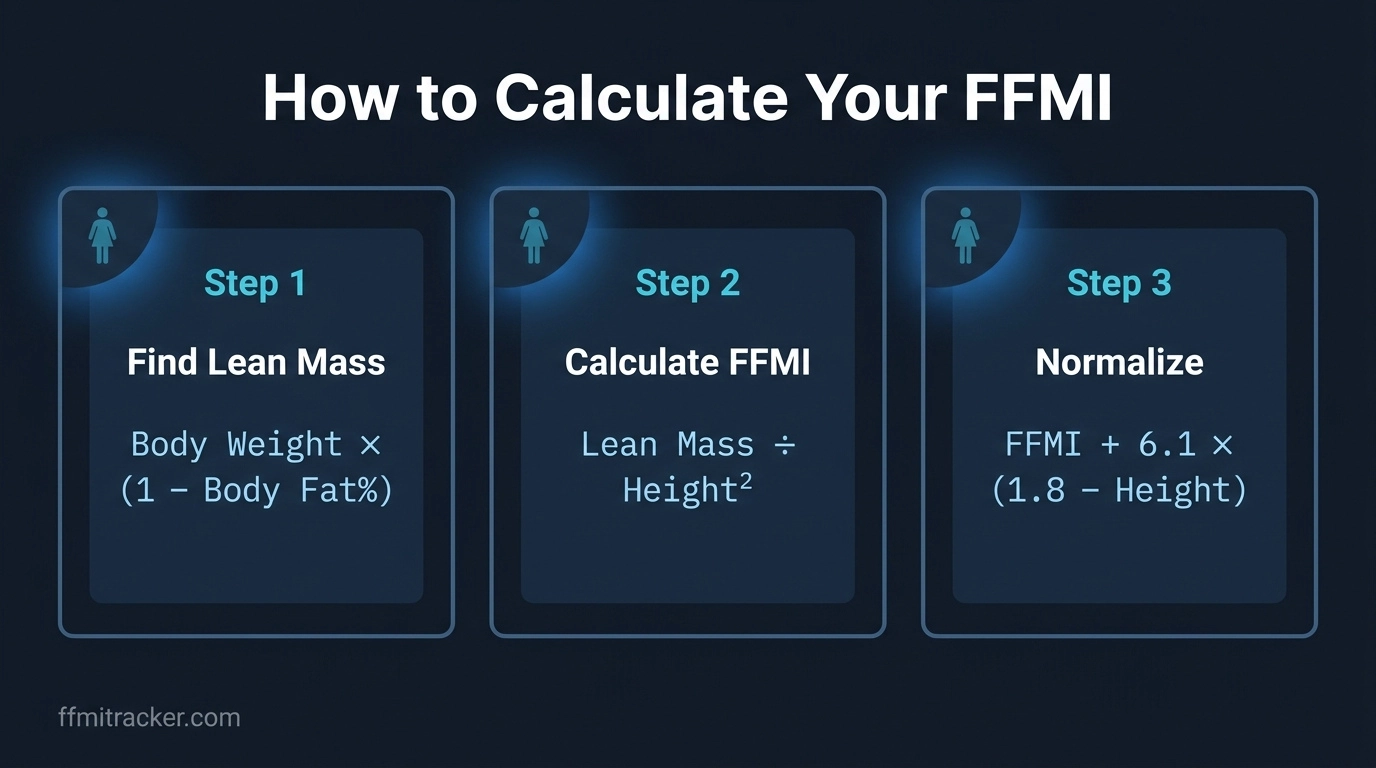
You need three numbers: total body weight in kg, body fat percentage, and height in meters. For a full walkthrough with worked examples, read how FFMI is calculated.
Step 1: Calculate your lean body mass
Lean Mass = Body Weight x (1 minus Body Fat divided by 100)
Example: A woman weighs 65 kg with 22 percent body fat.
Lean Mass = 65 x (1 minus 0.22) = 65 x 0.78 = 50.7 kg
Step 2: Calculate your raw FFMI
FFMI = Lean Mass / Height squared
Example: Height is 1.65 m.
FFMI = 50.7 / (1.65 x 1.65) = 50.7 / 2.72 = 18.6
Step 3: Normalize for height (optional but more accurate)
Normalized FFMI = FFMI + (6.3 x (1.8 minus Height in meters))
Example: FFMI = 18.6, Height = 1.65 m
Normalized FFMI = 18.6 + (6.3 x 0.15) = 18.6 + 0.9 = 19.5
The normalization step adjusts for the fact that taller people carry slightly more lean mass in absolute terms. For women shorter than 1.75 m (5 feet 9 inches), normalized FFMI will be a bit higher than the raw score.
If you want to skip the math, use the FFMI Calculator on this site.
Frequently Asked Questions
These are the most common questions we see from women about FFMI scores, what they mean, and how to improve them.
Is 38 percent muscle mass good for a woman?
Muscle mass percentage from a body composition scale and FFMI are different measurements. A reading of 38 percent typically falls in the normal to slightly above average range depending on your total body weight. FFMI uses lean body mass, which includes bone and organ mass, not muscle alone. You cannot directly convert one to the other without knowing your complete stats.
How rare is an FFMI of 22 for a woman?
Very rare. Based on competition data from natural federations, fewer than one in two hundred women who train seriously ever reach a normalized FFMI of 22. It takes years of optimal training, consistent nutrition, good genetics, and disciplined recovery. It is not a realistic short term goal for most women, and that is completely fine.
Can a 40 year old woman still improve her FFMI?
Yes. Muscle building slows after 40 but does not stop. Studies have documented significant lean mass gains in women in their 40s, 50s, and even 60s through resistance training. Your ceiling may be slightly lower than it would have been at 25, but your FFMI can still move meaningfully upward with the right training and nutrition.
Why does my FFMI look low if I feel strong and fit?
FFMI measures lean mass relative to height. It does not measure strength, cardiovascular fitness, or how you look. A woman who runs marathons and feels extremely fit may have a lower FFMI than a woman who lifts weights, because endurance training does not maximize lean mass. FFMI is one specific data point, not a full picture of your fitness.
Is FFMI more useful than BMI for women who train?
For trained women, yes. BMI does not distinguish between fat and muscle. A muscular woman often gets categorized as overweight or obese by BMI, which is simply wrong. FFMI separates lean mass from fat mass and gives a much more accurate picture of body composition for anyone who lifts.
What body fat percentage should women target alongside their FFMI?
For general health, 20 to 30 percent body fat is a normal range for adult women. For visible muscle definition and athletic performance, most women find 18 to 24 percent optimal. Dropping below 15 percent carries real risks including hormonal disruption and bone density loss. For most women, 15 percent body fat is not a goal worth chasing.
Does FFMI use the same formula for women as for men?
The formula is the same: lean mass divided by height squared. But the ranges that define “good” or “athletic” or “natural ceiling” are different for women because female physiology supports less absolute lean mass than male physiology. Using male benchmarks to evaluate a female FFMI score gives misleading results.
The Bottom Line on FFMI for Women
FFMI gives women a fairer way to judge muscle than the scale or BMI ever will. If you are untrained, a score of 14 to 16 is normal. If you lift a few times a week, 17 to 19 is a solid target. Scores of 20 to 22 take years of hard training and good genetics. Compare yourself to female data, not male charts, and check your number every few months instead of every week.
Written by the FFMI Tracker team. This content is based on published research including the Kouri et al. 1995 study in the Clinical Journal of Sport Medicine and the 2019 normative data study (PMID 30893018) in the International Journal of Exercise Science. For the FFMI calculator and score ranges, all formulas are referenced from peer reviewed literature.
References and Sources
- Kouri EM et al. Fat-Free Mass Index in Users and Nonusers of Anabolic-Androgenic Steroids. Clinical Journal of Sport Medicine. 1995. PubMed
- Kasper AM et al. Body Composition Norms in Female Collegiate Athletes. International Journal of Exercise Science. 2019. PMID 30893018. PubMed
- Stokes T et al. Recent Perspectives Regarding the Role of Dietary Protein for the Promotion of Muscle Hypertrophy. Nutrients. 2018. NIH
- Tipton KD. Efficacy and consequences of very high protein intakes in humans. Journal of Nutrition. 2011. PubMed
- World Natural Bodybuilding Federation (WNBF) Drug Testing Standards. WNBF Official Site