Quick Summary
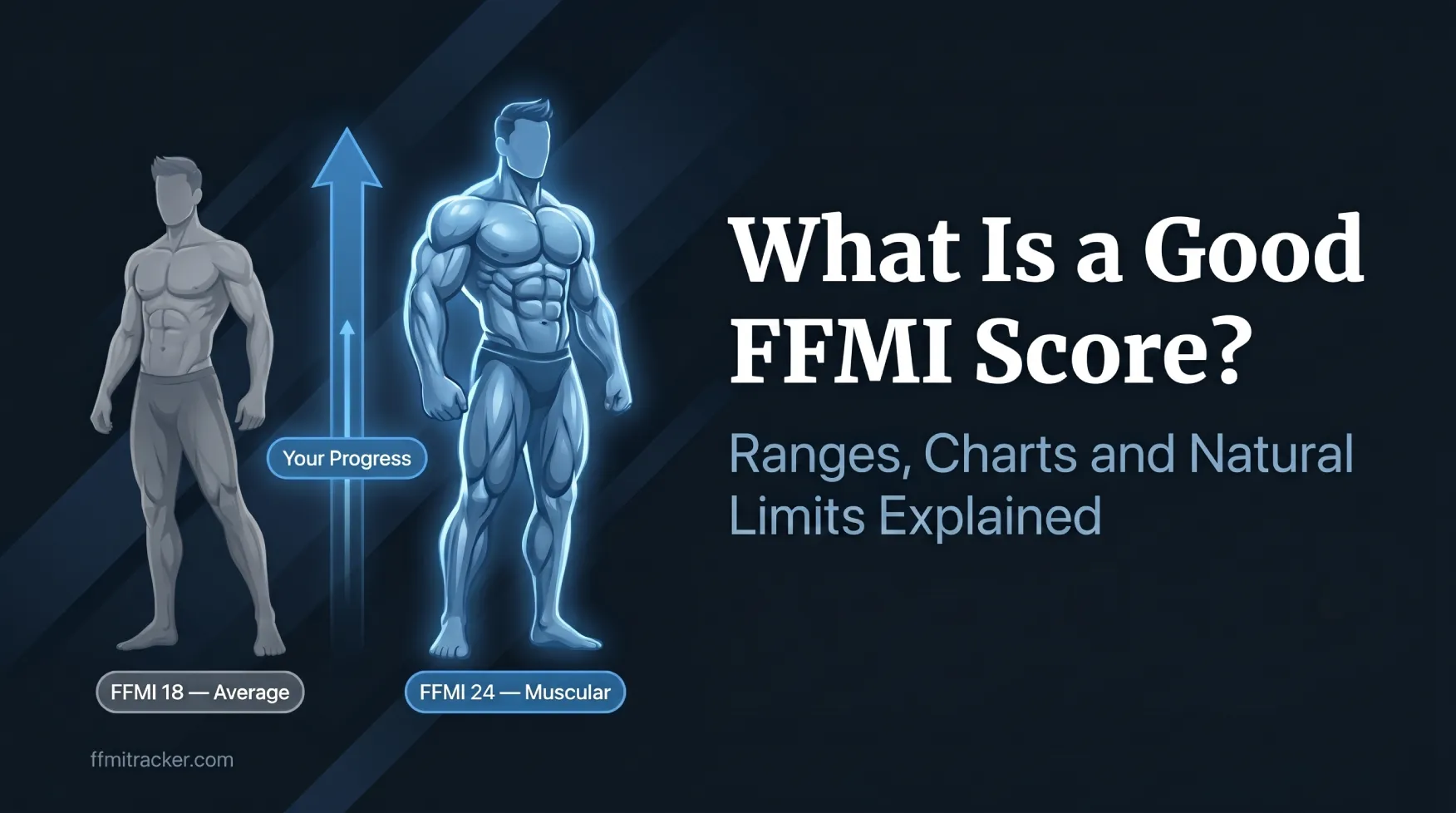
A good FFMI score depends on your gender, training experience, and goals. For men, a score between 20 and 22 is considered athletic and above average. For women, the equivalent range is 17 to 19. Most dedicated natural lifters reach their peak between 22 and 25 for men and 19 to 21 for women after several years of consistent training. Scores above 25 for men and 22 for women are rare naturally and represent the upper limit of what most people can achieve without performance enhancing substances.
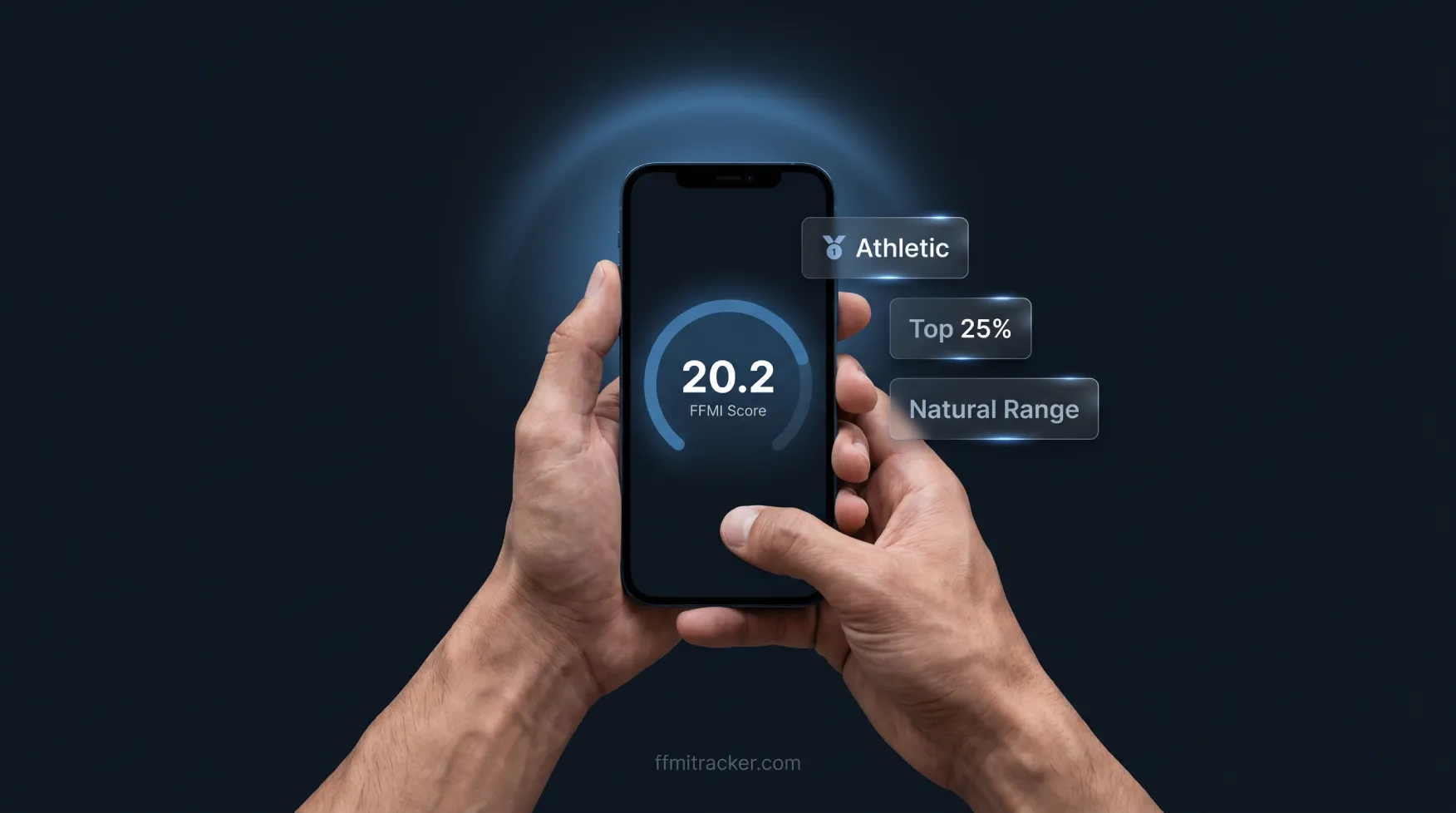
You calculated your FFMI score. Now you are staring at a number and wondering if it is good or not.
That is the most common question after someone uses an FFMI calculator for the first time. The number alone means nothing without context. A score of 20 might be excellent for one person and average for another depending on how long they have been training, their gender, and their natural build.
In this guide you will find the exact ranges for men and women, a breakdown by training level, how your score compares to the general population, and what research actually says about the natural upper limit.
What Does a Good FFMI Score Actually Mean?
A good FFMI score is not a single number. It is a range that shifts based on your gender, how long you have been training, and your natural body structure.
Think of it this way. A score of 20 for a man who just started going to the gym six months ago is an outstanding result. The same score for someone who has been lifting seriously for five years tells a different story. Context is everything.
That is why FFMI is more useful as a personal progress tracker than as a fixed target to chase. The goal is not to hit a specific number. The goal is to watch your number rise over time as you build real lean muscle.
Three things shape what a good score looks like for you:
Your Gender
Men naturally carry more lean muscle than women because of higher testosterone levels. This means their FFMI ranges are higher. A score of 19 for a woman is equivalent in terms of effort and dedication to a score of 23 for a man.
Your Training Experience
The longer you have been training consistently, the higher your score should be. A beginner and an advanced lifter cannot be measured against the same standard.
Your Genetics
Some people build muscle faster and carry more of it naturally. This affects your ceiling but not your ability to make progress from wherever you start. An athletic physique is not built overnight. It is the result of consistent effort measured over months and years. If you want to understand how FFMI compares to BMI before interpreting your score, read our FFMI vs BMI guide first.
FFMI Score Ranges for Men
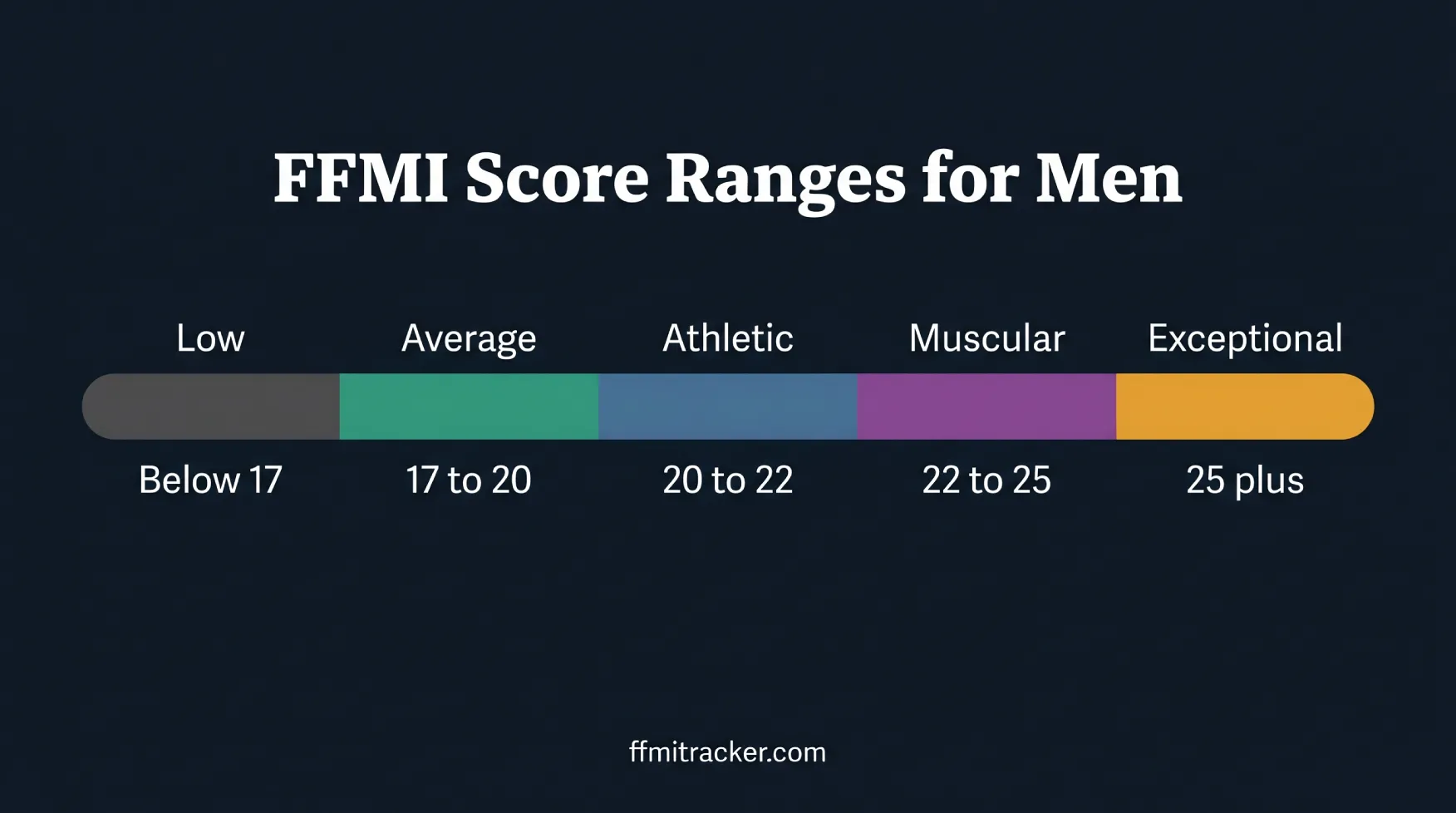
For men, FFMI scores fall into five clear levels. These ranges come from two sources: the Kouri et al. 1995 research on natural athletes and the NHANES III study which analyzed 16,907 healthy adults across the United States.
Score Range | Level | What It Means |
Below 17.4 | Low | Minimal muscle development or high body fat |
17.5 to 19.7 | Average | Normal healthy adult general population range |
20 to 22 | Athletic | Consistent training over 1 to 3 years |
22 to 25 | Muscular | Several years of serious structured training |
25 and above | Exceptional | Rare naturally. Requires elite genetics |
The NHANES data shows the median FFMI for a healthy adult man is 19.16. This means half of all healthy men in the general population fall below this number. If you are already above 20, you are ahead of most people your age regardless of whether they train or not.
A score above 23 places you in the top 10% of natural lifters. Very few people reach this without 5 or more years of consistent effort.
FFMI Score Ranges for Women
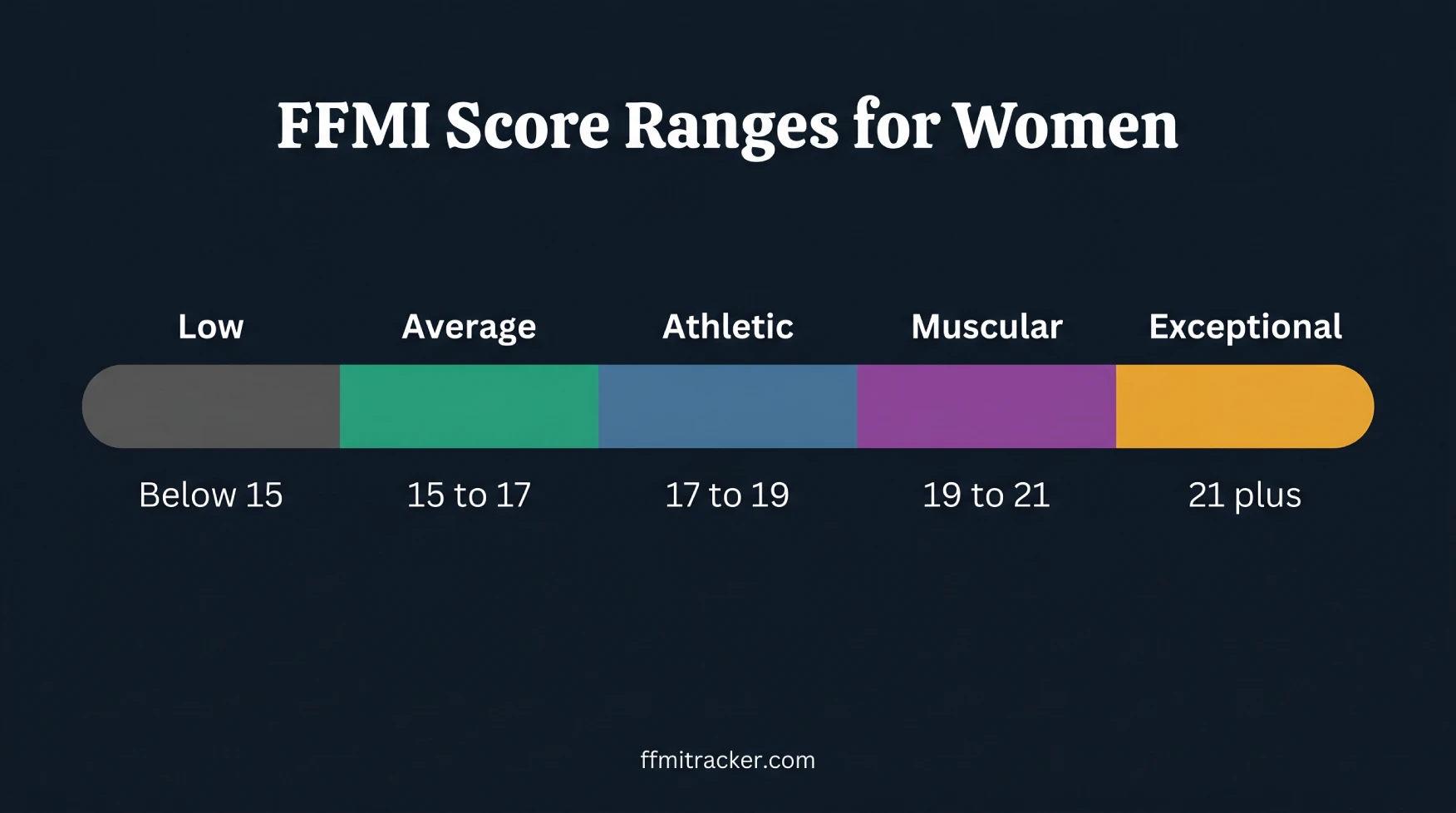
Women naturally carry less lean muscle than men because of differences in hormones, particularly testosterone levels. This is why female FFMI ranges are lower. It does not mean the effort required is any less. A woman at 19 has achieved something just as impressive as a man at 23.
These ranges are based on the same NHANES III study data and Kouri et al. research used for men.
Score Range | Level | What It Means |
Below 15.0 | Low | Minimal muscle development or very early training stage |
15.1 to 16.6 | Average | Normal healthy adult in the general population |
17 to 19 | Athletic | Regular training with visible muscle tone |
19 to 21 | Muscular | Advanced training with consistent structured effort |
21 and above | Exceptional | Very rare naturally. Requires elite genetics |
The NHANES data shows the median FFMI for a healthy adult woman is 15.96. This means the average woman in the general population sits right at the bottom of the average range. Any score above 17 already places you above the majority of women your age.
A score of 19 or above for a woman represents elite level muscle development that takes many years of dedicated training to reach.
Good FFMI Score by Training Level
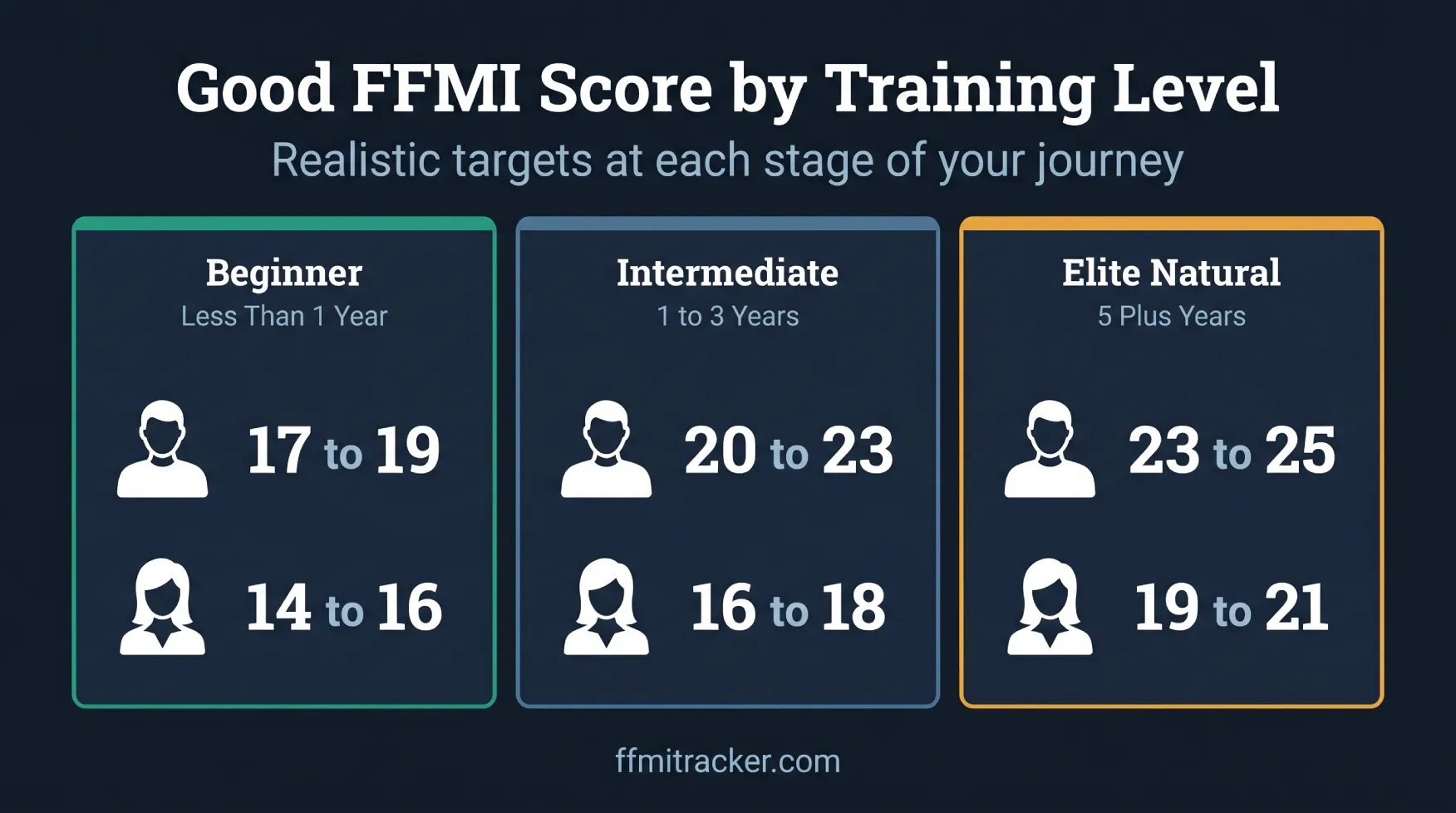
A beginner should target an FFMI of 17 to 19 for men and 14 to 16 for women. An intermediate lifter should aim for 20 to 23 for men and 16 to 18 for women. Elite natural lifters with 5 or more years of training can realistically reach 23 to 25 for men and 19 to 21 for women.
Here is a detailed breakdown of what to expect at each stage.
Beginners (Less Than 1 Year)
If you have been training for less than a year, your body is still in its early adaptation phase. Muscle growth happens fastest during this period.
Gender | Realistic Target Range |
Men | 17 to 19 |
Women | 14 to 16 |
Do not compare yourself to people who have been lifting for years. Focus on building consistent habits and getting your body fat under control. Even reaching 18 as a man in your first year is a solid result.
Intermediate (1 to 3 Years)
At this stage your body has adapted to training and real muscle development is visible. Your score should be climbing steadily.
Gender | Realistic Target Range |
Men | 20 to 23 |
Women | 16 to 18 |
Most people who train 3 to 4 times per week with a structured program land in this range after 2 to 3 years. If your score is not improving, it usually means your nutrition needs attention more than your training.
Elite Natural (5 Plus Years)
At this level you are approaching your natural genetic ceiling. Progress is slower but the results are more impressive.
Gender | Realistic Target Range |
Men | 23 to 25 |
Women | 19 to 21 |
Reaching this range takes years of consistent work, good sleep, structured nutrition, and progressive overload in your training. Very few people get here. If you are in this range naturally you are in a small group.
How Your Score Compares to the General Population
Most people who calculate their FFMI for the first time are surprised by where they land. That is because the general population includes a large number of people who do not train at all. When you compare yourself to everyone, not just gym goers, your score often looks better than you expected.
Here is what the NHANES III data tells us about where most healthy adults actually sit:
Percentile | Men FFMI | Women FFMI |
10th percentile | 16.8 | 14.4 |
25th percentile | 17.9 | 15.1 |
50th percentile (midpoint) | 19.2 | 16 |
75th percentile | 20.4 | 16.9 |
90th percentile | 21.4 | 17.7 |
What this table tells you is simple. If your FFMI is above 20 as a man you are already in the top 25% of the general adult population. For women, a score above 17 places you in the top 25%.
This does not mean you should stop progressing. It simply gives you an honest picture of where you stand relative to the real world, not just gym standards.
Good FFMI Score by Sport
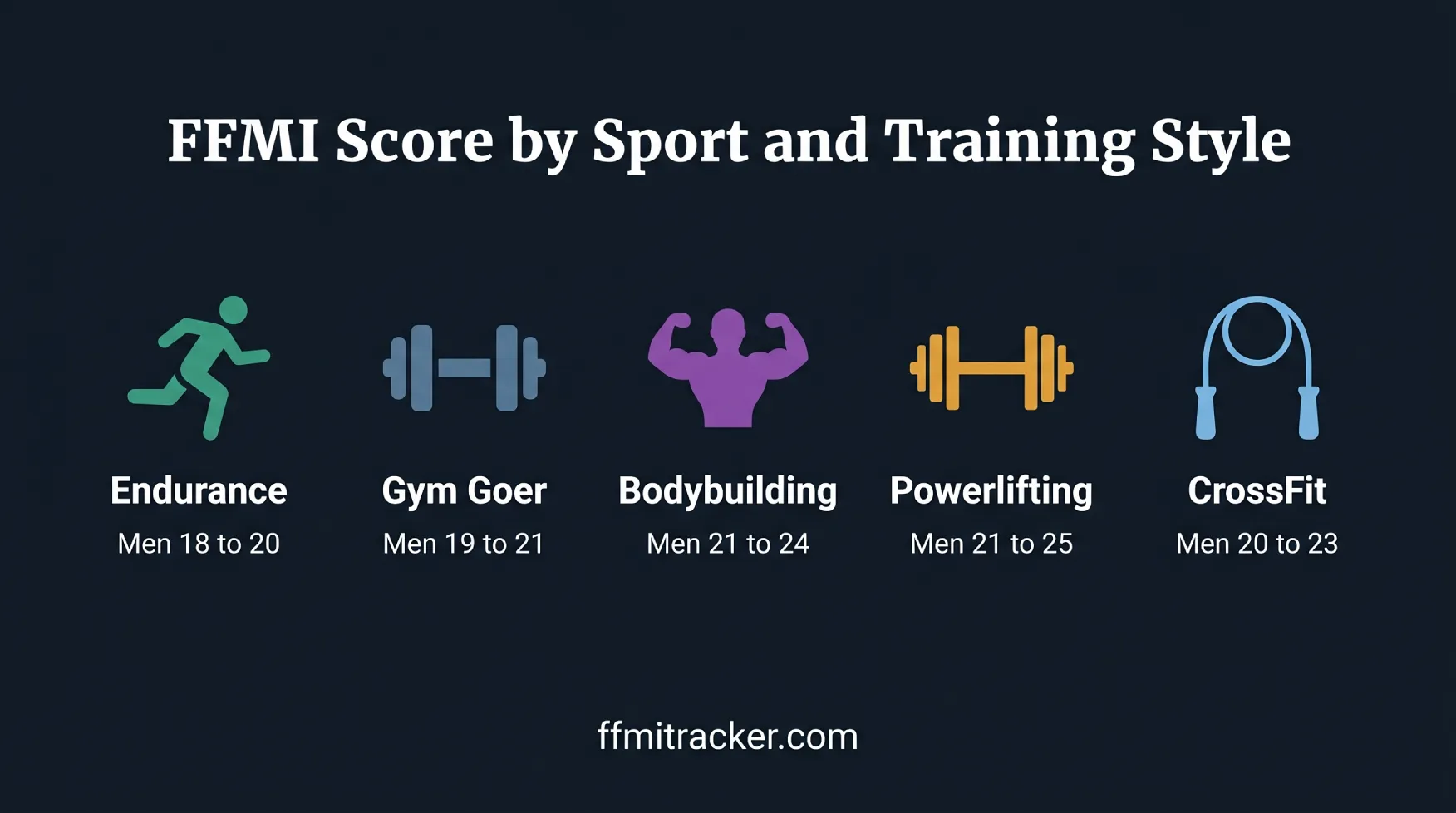
Different sports produce different body compositions. A marathon runner and a powerlifter can both be at peak fitness but their FFMI scores will look completely different. Knowing where your sport typically lands helps you set realistic expectations.
Sport | Typical Men | Typical Women |
Endurance running or cycling | 18 to 20 | 15 to 17 |
Recreational gym goer | 19 to 21 | 16 to 18 |
Natural bodybuilding | 21 to 24 | 17 to 20 |
Powerlifting | 21 to 25 | 17 to 21 |
CrossFit or functional fitness | 20 to 23 | 17 to 20 |
Collegiate American football | 22 to 25 | N/A |
The football data comes from a published NCAA Division III study which found an overall mean FFMI of 23.5 among players, with linemen reaching as high as 24.8.
A score of 19 for an endurance runner is excellent. The same score for a powerlifter suggests significant room to grow. Always compare yourself within your own sport and training style.
The Natural FFMI Ceiling and What Research Actually Says
The highest FFMI most people can reach naturally is around 25 for men and 21 for women. This comes from a 1995 study by Kouri, Pope, Katz, and Oliva which analyzed 157 male athletes and found that natural lifters consistently scored below 25 while steroid users scored well above it.
Pre-steroid era bodybuilders like Steve Reeves and Reg Park had estimated FFMI values between 24.5 and 25.2. This shows that reaching 25 naturally is possible but only with elite genetics and many years of work.
For most natural lifters the realistic ceiling is 21 to 23 for men and 17 to 19 for women. Scores above 25 for men and 21 for women are rare and usually require exceptional genetics.
How Body Fat Accuracy Affects Your Score
Body fat percentage is the most important input in the FFMI formula. If this number is wrong your final score will also be wrong.
A common mistake people make is estimating their body fat by looks alone. Visual estimation can easily be off by 5 percentage points or more. That kind of error can shift your FFMI by 1 to 2 points in either direction.
For example, if you think your body fat is 15% but it is actually 20%, your FFMI will appear higher than it really is. This gives you a false picture of your actual muscle level.
The most important thing is not to find the perfect measurement method. It is to use the same method every time. This keeps your results consistent and your progress tracking meaningful.
For a detailed breakdown of the best ways to measure body fat, you can read our complete guide on how to calculate your FFMI.
FFMI and Healthy Aging: Why It Matters After 40
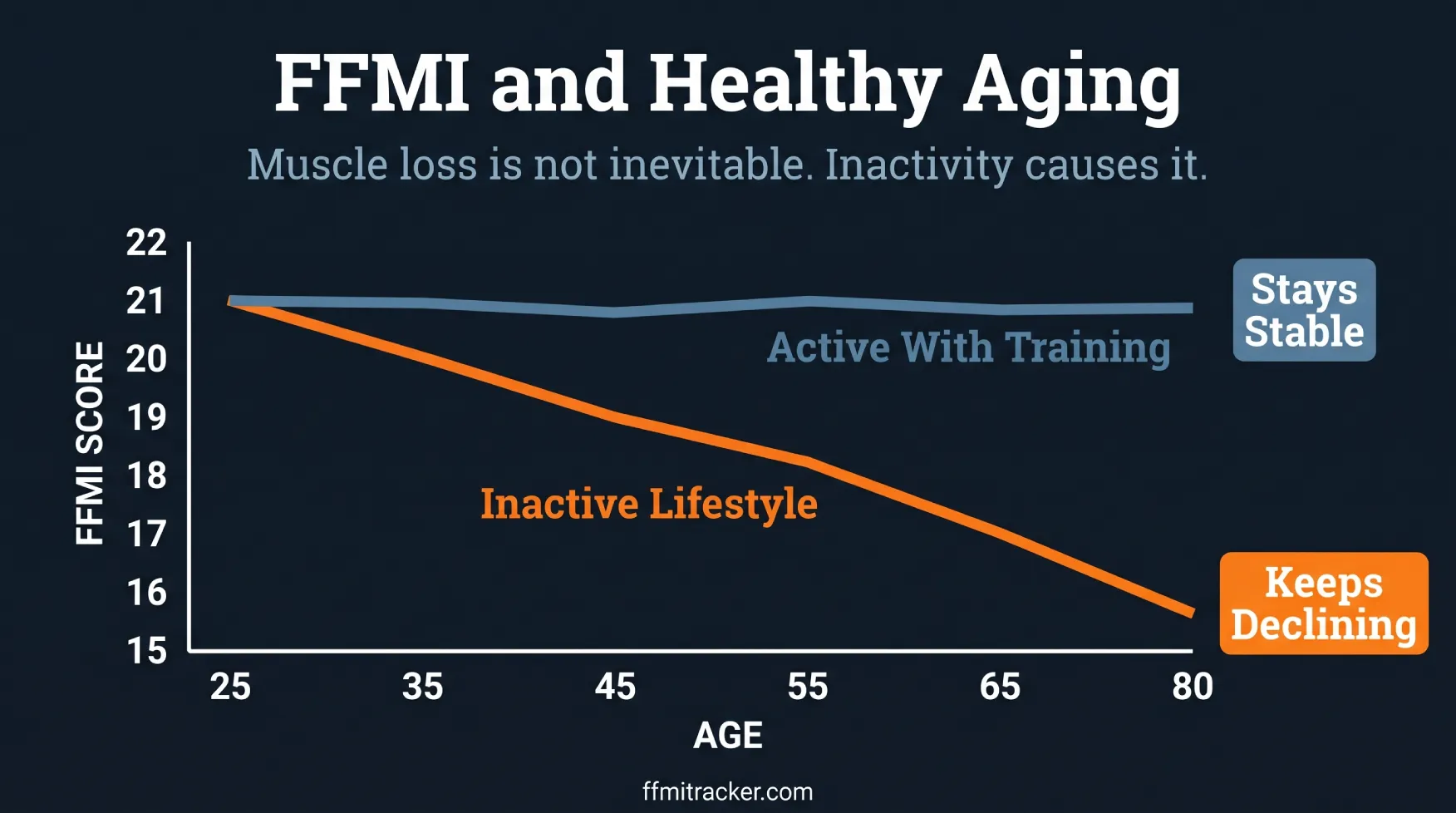
Most people think of FFMI as a tool for young athletes. But it becomes even more important as you get older.
After your mid-30s your body naturally starts losing muscle mass. This process is called sarcopenia and it happens to everyone who does not actively work against it. Research published in the American Journal of Clinical Nutrition found that higher muscle mass in older adults was linked to better survival rates and lower risk of age related complications.
This means that maintaining a healthy FFMI as you age is not just about looking muscular. It is about staying strong, mobile, and independent for longer.
The NHANES data also showed that FFMI remains relatively stable between ages 25 and 80 in healthy weight adults. This tells us that muscle loss with age is not inevitable. It is largely a result of inactivity.
If you are over 40, do not compare your score to a 25 year old. Instead track your own score over time. Body recomposition becomes especially important after 40 because it allows you to build or maintain lean mass while managing body fat at the same time. Keeping your score stable as you age is itself a meaningful achievement.
How to Improve Your Score
Improving your FFMI means building more lean muscle while keeping body fat under control. Since your height does not change, these are the only two variables you can work with.
Focus on Resistance Training
Muscle grows when it is consistently challenged. Train each muscle group at least twice per week using compound movements like squats, deadlifts, bench press, and rows. Increase your weight or reps gradually over time. This is called progressive overload and it is the most important driver of muscle growth. Consistent resistance training over months and years is what drives hypertrophy and raises your score in a meaningful way.
Eat Enough Protein
Research shows that 1.6 to 2.2 grams of protein per kilogram of body weight per day is the range that supports muscle growth. Without enough protein your body cannot repair and build muscle tissue no matter how hard you train.
Manage Body Fat
A lower body fat percentage directly improves your FFMI score even if your lean mass stays the same. During a fat loss phase keep your protein intake high and continue resistance training to protect the muscle you have built.
Frequently Asked Questions
What is a good FFMI score for a natural lifter?
For men 20 to 22 is a solid athletic range achievable with 2 to 3 years of consistent training. For women the equivalent range is 17 to 19. Most dedicated natural lifters plateau between 22 and 24 for men and 19 to 21 for women after several years of serious work.
Is an FFMI of 25 achievable naturally for men?
It is possible but rare. Research by Kouri et al. shows most natural athletes peak below 25. Pre-steroid era bodybuilders like Steve Reeves estimated between 24.5 and 25.2. Elite genetics and many years of training are required to get there.
What is the average FFMI for men and women?
According to the NHANES III study the midpoint FFMI for healthy adult men is 19.2 and for women it is 16.0. These are general population averages including people who do not train at all.
What does an FFMI of 20 mean for a man?
It means you are above the general population average and in the athletic range. A score of 20 typically reflects 1 to 2 years of consistent training with good nutrition. It is a result worth being proud of.
Does FFMI change with age?
NHANES data shows FFMI remains relatively stable between ages 25 and 80 in healthy weight adults. However muscle mass naturally declines with inactivity. Staying active and eating enough protein helps maintain your score as you get older.
How often should I check my FFMI?
Every 8 to 12 weeks is enough. Muscle changes slowly and checking too often just creates noise. Use the same body fat measurement method each time for consistent results.
Can women use the same FFMI ranges as men?
No. Women naturally carry less lean mass due to hormonal differences. Always use female specific ranges when interpreting your result. A score of 17 to 19 for a woman is equivalent in effort to 20 to 22 for a man.
Conclusion
Your FFMI score is not just a number. It is a reflection of the work you have put in and a guide for where you can still go.
Most people who calculate their score for the first time land between 18 and 21. That is your starting point, not your limit. The ranges in this guide give you a realistic picture of what is achievable at each stage of your training journey.
Check your score every few months, keep your body fat measurement consistent, and focus on slow steady progress over time. The ranges and data in this guide are based on peer reviewed research and population studies used by fitness professionals and researchers worldwide. Use our FFMI calculator to get your current score right now.
Note: This guide is for educational and informational purposes only. Always consult a qualified health or fitness professional before making changes to your training or nutrition.