Quick Summary
BMI and FFMI both use height and weight in their calculations but they measure completely different things. BMI looks at your total body weight and cannot tell the difference between muscle and fat. FFMI removes body fat from the equation first and measures only your lean muscle mass relative to your height. For anyone who exercises regularly, lifts weights, or wants to track real muscle progress, FFMI gives a far more accurate and useful result than BMI ever can.
Most people have heard of BMI. It is the number doctors use to tell you if your weight is healthy or not. But if you train regularly and still get told your BMI is too high, you already know something about this measurement does not add up. The truth is BMI was never designed to measure fitness. It cannot tell the difference between muscle and fat.
That is where FFMI comes in. The Fat-Free Mass Index measures your lean muscle mass relative to your height by removing body fat from the calculation entirely. In this guide you will learn exactly how BMI and FFMI differ, which one is right for you, and how to use the right metric to track your real fitness progress.
The Problem With BMI That Nobody Talks About
BMI has been used as a health measurement for over 200 years. It was first described in 1832 by a Belgian mathematician named Adolphe Quetelet and was later named Body Mass Index in 1972 by researcher Ancel Keys. He was not a doctor and he never intended it to measure individual health. He created it to study average body proportions across large populations.
That is the core problem. A tool built for population studies is now being used to judge individual fitness levels. And for anyone who trains regularly, this creates a very misleading picture.
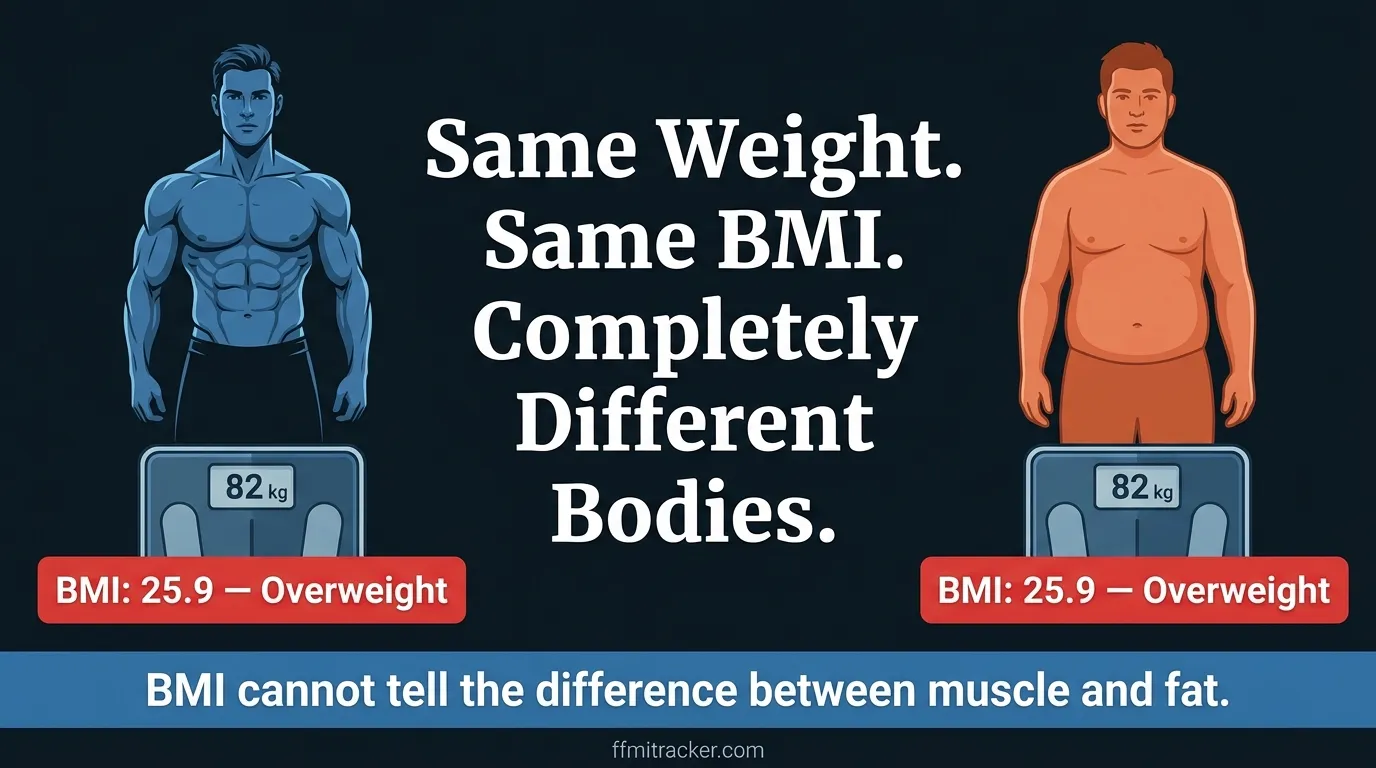
Here is why. BMI calculates your total body weight divided by your height squared. It does not know how much of your weight is muscle and how much is fat. This means a 90 kg athlete with 10% body fat and a 90 kg sedentary person with 35% body fat will receive the exact same BMI score.
A study published in the Clinical Journal of Sport Medicine found that BMI consistently failed to distinguish between muscular and overweight individuals in trained athletes. This misclassification is not a rare exception. It is a structural flaw built into the formula itself.
If you have ever felt fit and healthy but been told your BMI puts you in the overweight category, this is exactly why.
What Is BMI?
Body Mass Index is a simple calculation that uses your total body weight and height to produce a single number. That number is then used to place you into one of four categories: underweight, normal weight, overweight, or obese.
It is used by doctors, governments, and public health organizations around the world because it is fast, free, and requires no special equipment. You only need two measurements to get your result.
How BMI Is Calculated
The formula is straightforward.
BMI = Weight in kilograms divided by Height in meters squared
For example, if you weigh 80 kg and your height is 1.75 m, your BMI would be:
80 divided by (1.75 x 1.75) = 80 divided by 3.06 = BMI of 26.1
A score of 26.1 places you in the overweight category according to standard BMI charts. But this number tells you nothing about how much of that 80 kg is muscle and how much is fat.
Who BMI Was Originally Designed For
BMI was designed for large scale population studies, not individual fitness assessment. It works reasonably well for sedentary individuals with average body types. But it breaks down completely when applied to athletes, bodybuilders, or anyone who carries more muscle than average.
The World Health Organization still uses BMI as a screening tool for obesity at the population level. At that scale it provides useful trends. At the individual level especially for active people it is far too simple to be reliable.
What Is FFMI?
The Fat-Free Mass Index is a body composition measurement that tells you how muscular your body is relative to your height. Unlike BMI it does not look at your total body weight. It removes body fat from the calculation first and measures only your lean muscle mass.
This single difference is what makes FFMI a far more accurate and honest tool for anyone who exercises regularly or wants to track real muscle progress.
To understand exactly how FFMI is calculated step by step including the full formula and worked examples, read our complete guide.
FFMI vs BMI: Full Comparison
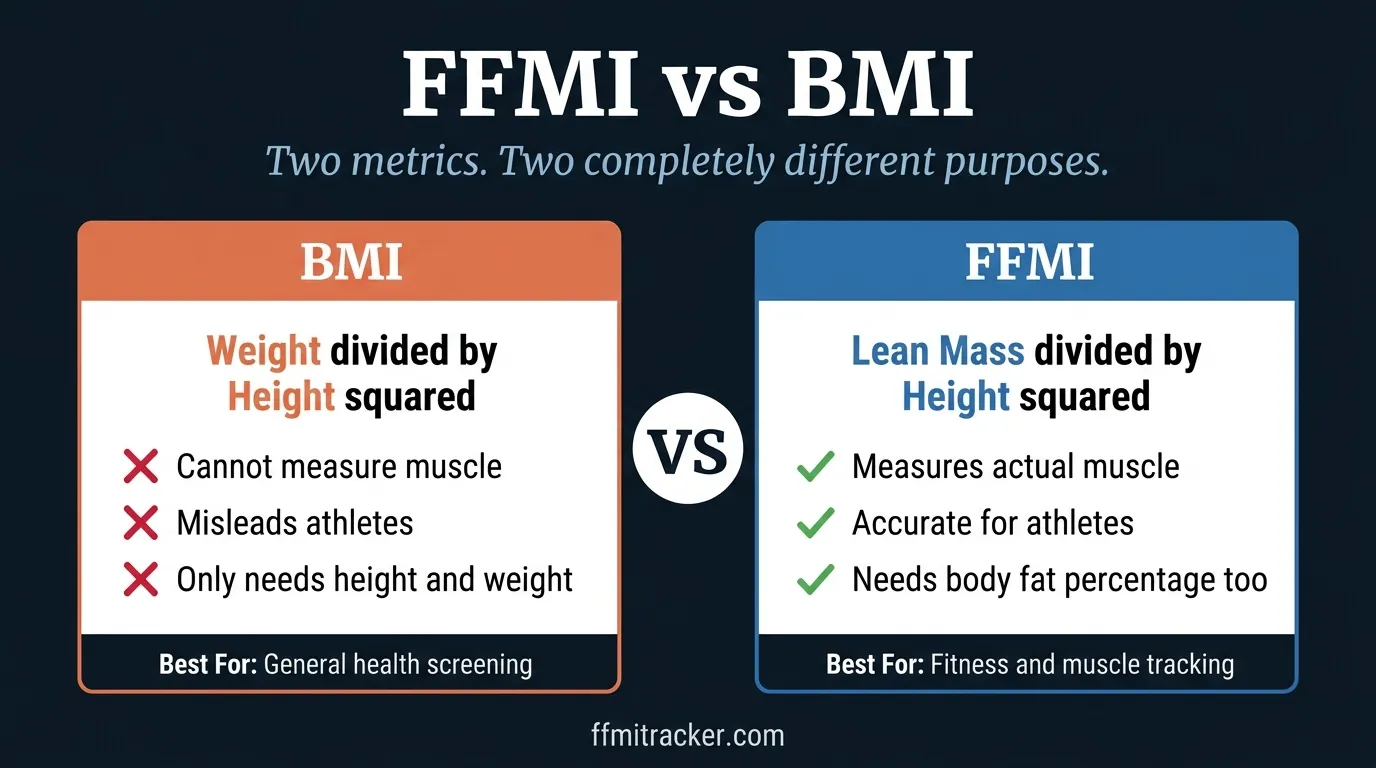
Now that you understand both measurements separately, it is easy to see why they produce such different results. BMI and FFMI are not competing versions of the same tool. They measure completely different things and serve completely different purposes.
Basic Information
Feature | BMI | FFMI |
Full Name | Body Mass Index | Fat-Free Mass Index |
Created By | Adolphe Quetelet 1832 | Kouri et al. 1995 |
Required Inputs | Height and weight | Height, weight and body fat percentage |
Formula | Weight divided by Height squared | Lean Mass divided by Height squared |
Performance Comparison
Feature | BMI | FFMI |
Measures Body Fat | No | Yes |
Measures Muscle | No | Yes |
Accurate for Athletes | No | Yes |
Best Used For | Population health screening | Fitness and muscle tracking |
Main Limitation | Cannot separate muscle from fat | Needs accurate body fat input |
The most important row in that second table is accuracy for athletes. BMI scores a clear No. FFMI scores a clear Yes. That single difference explains why a muscular athlete and an overweight person can have identical BMI scores but completely different FFMI scores.
For anyone who trains regularly, lifts weights, or cares about their body composition, FFMI is the more meaningful number. BMI simply does not have enough information to give you an accurate picture of your actual fitness level.
Real Life Example: Same Weight, Different Results
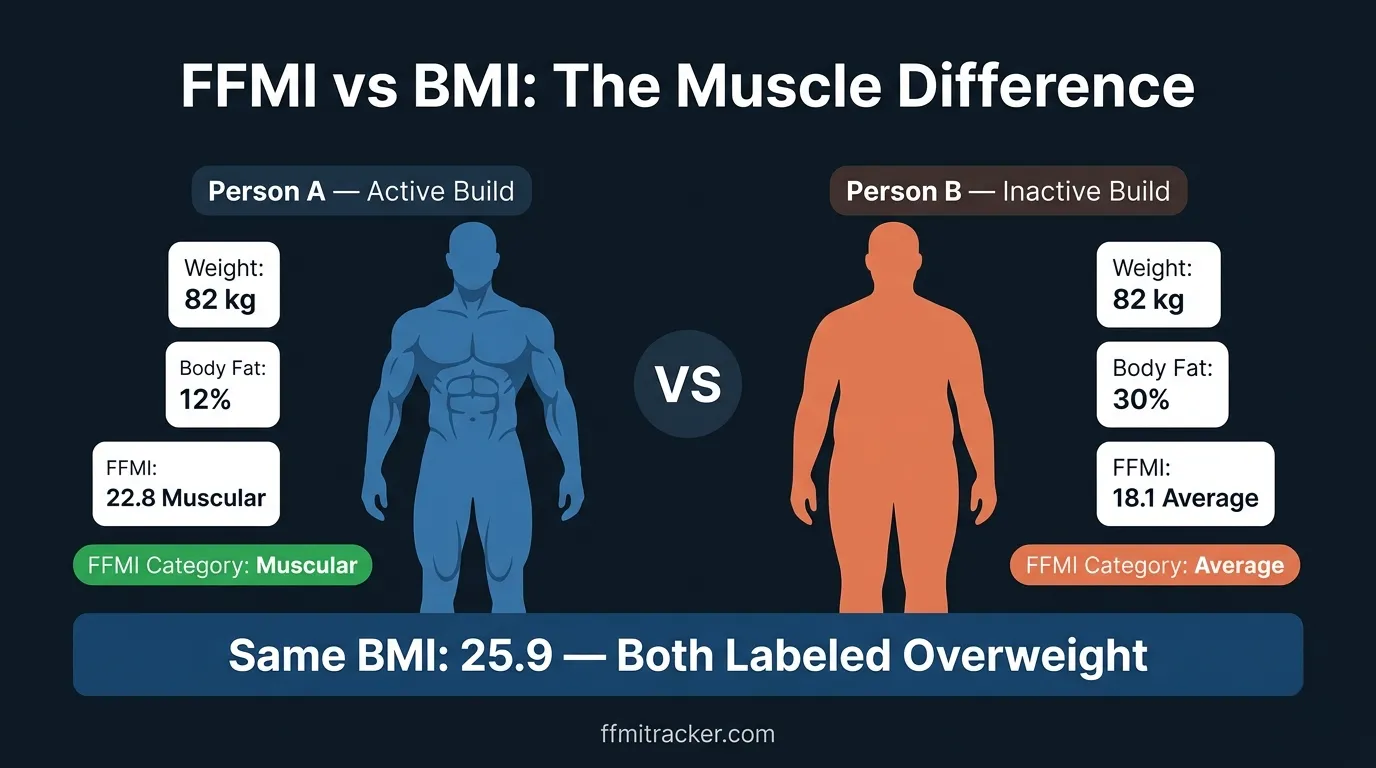
The best way to understand the difference between BMI and FFMI is to see both calculations applied to real numbers. Here are two people with the exact same weight and height but completely different body compositions.
Person A: Athletic Build
Weight: 82 kg Height: 1.78 m Body Fat: 12%
BMI Calculation: 82 divided by (1.78 x 1.78) = 82 divided by 3.17 = BMI of 25.9
BMI Category: Overweight
FFMI Calculation: Lean Mass = 82 x (1 minus 0.12) = 82 x 0.88 = 72.2 kg FFMI = 72.2 divided by 3.17 = FFMI of 22.8
FFMI Category: Muscular
Person B: Inactive Build
Weight: 82 kg Height: 1.78 m Body Fat: 30%
BMI Calculation: 82 divided by (1.78 x 1.78) = 82 divided by 3.17 = BMI of 25.9
BMI Category: Overweight
FFMI Calculation: Lean Mass = 82 x (1 minus 0.30) = 82 x 0.70 = 57.4 kg FFMI = 57.4 divided by 3.17 = FFMI of 18.1
FFMI Category: Average
Both people have an identical BMI of 25.9 and both are labeled overweight. But their FFMI scores tell a completely different story.
Person A has an FFMI of 22.8 which places them in the muscular range. Person B has an FFMI of 18.1 which places them in the average range. Same weight. Same height. Same BMI. Completely different bodies.
This is exactly why BMI alone is not enough. You can check your own numbers right now using our free FFMI calculator.
When BMI Is Actually Useful
BMI works best for general population health screening and for people who do not exercise regularly. It has a specific purpose and within that purpose it does its job well.
For general population screening Governments and health organizations use BMI to track weight related health problems across large populations. It is fast, free, and requires no special equipment.
For people who do not exercise If someone lives an inactive lifestyle and does not carry extra muscle, BMI gives a reasonable estimate of how much extra body fat they have.
For quick initial health checks Doctors use BMI as a starting point during routine checkups. It is not the final answer but it tells them whether to look further into a person’s weight and health.
For tracking general weight trends If you are not athletic, checking your BMI every few months can show whether your weight is going up or down over time.
The key point is this. BMI works well for inactive people and large scale health studies. The moment regular training and muscle building enter the picture, FFMI becomes the better and more honest choice.
When You Should Use FFMI Instead
FFMI becomes the right choice the moment you start living an active lifestyle. If any of the following apply to you, FFMI will give you a much more useful result than BMI.
You go to the gym regularly If you train 2 or more times per week through progressive overload and resistance training your body carries more muscle than average. Hypertrophy builds lean mass over time and BMI cannot account for this change. FFMI can.
You want to track real muscle progress The scale does not show you whether you gained muscle or lost fat. FFMI does. It shows exactly what is changing in your body over time.
BMI says overweight but you feel fit This is the most common frustration for people who train consistently. A high BMI does not mean you are unhealthy. FFMI will show you the real picture.
You want a goal that actually means something Working toward a specific FFMI score gives you a clear and meaningful fitness target. Whether your goal is body recomposition, strength training, or simply building a better physique, FFMI tracks what actually matters.
How to Get Your Body Fat Percentage
Body fat percentage is the most important input in the FFMI formula. If this number is wrong your final score will also be wrong. The good news is you do not need a perfect measurement. You just need a consistent one.
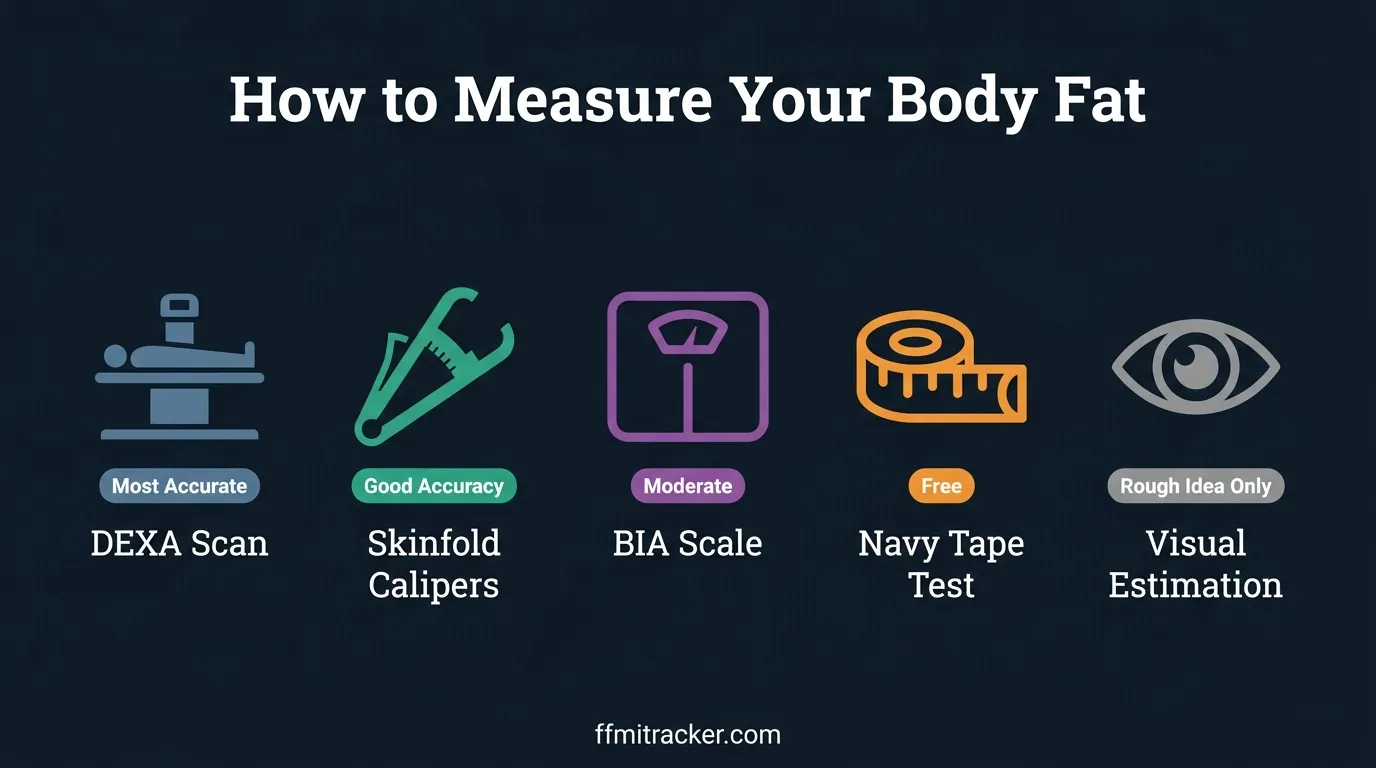
Here are the most common ways to measure it:
Method | How Accurate | Cost | Best For |
DEXA Scan | Very High (1 to 2% error) | High | Most precise reading available |
Skinfold Calipers | Good (3 to 5% error) | Low | Regular tracking at home or gym |
BIA Body Fat Scale | Moderate (3 to 8% error) | Low to Medium | Tracking trends over time |
Navy Tape Test | Moderate (3 to 5% error) | Free | Quick estimate with no equipment |
Visual Estimation | Low (5 to 10% error) | Free | Rough idea only |
For most people a BIA body fat scale or the Navy Tape Test is enough to get started. They are affordable, easy to use, and give you a consistent number to work with over time.
The most important thing is to use the same method every time you measure. This keeps your results consistent and makes your FFMI tracking meaningful month after month.
FFMI Score Ranges at a Glance
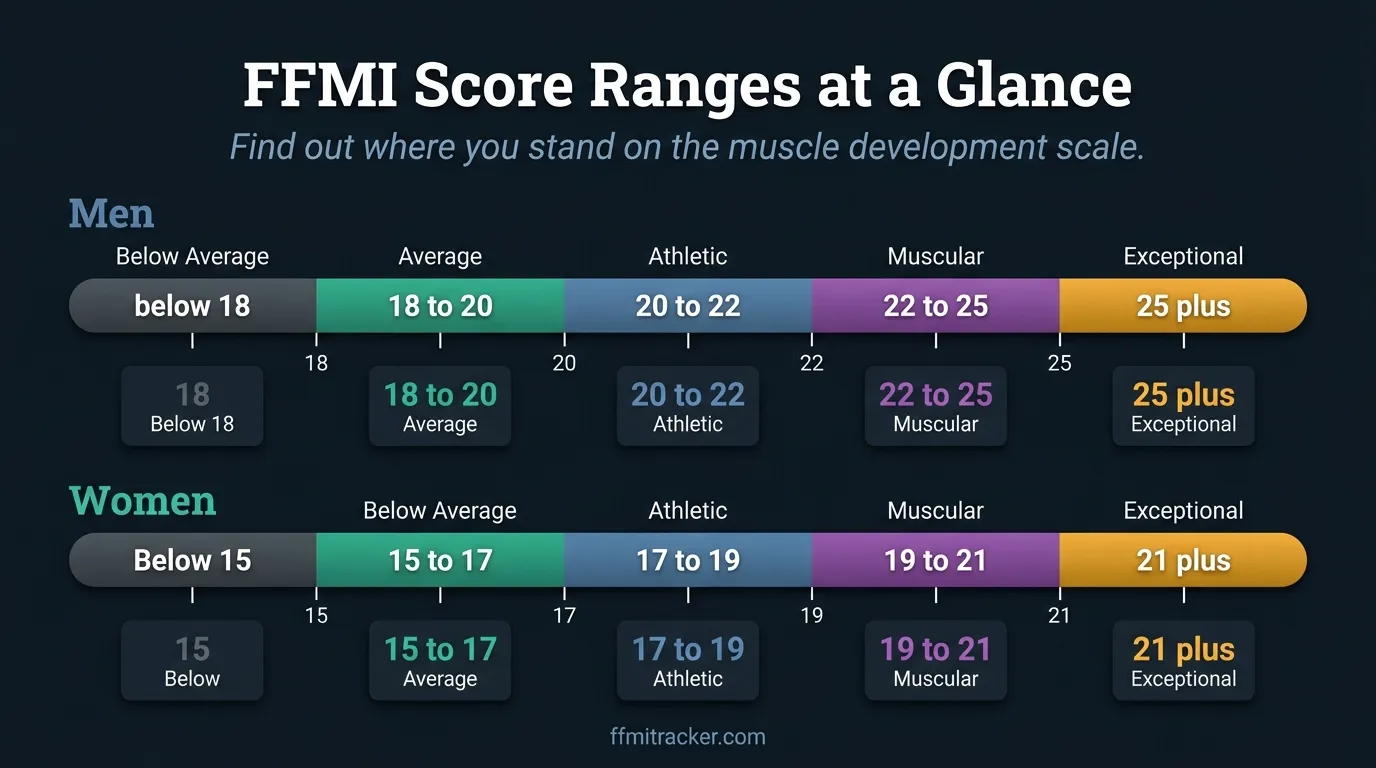
Once you have your FFMI score the next step is understanding what it actually means. Here are the reference ranges for both men and women.
For Men
Score Range | Level | What It Means |
Below 18 | Below Average | Limited training history or high body fat |
18 to 20 | Average | Normal healthy adult with some activity |
20 to 22 | Athletic | Consistent training over 1 to 3 years |
22 to 25 | Muscular | Several years of serious structured training |
25 and above | Exceptional | Rare naturally. Requires elite genetics |
For Women
Score Range | Level | What It Means |
Below 15 | Below Average | Minimal training or very early stage |
15 to 17 | Average | Normal healthy adult with light activity |
17 to 19 | Athletic | Regular training with visible muscle tone |
19 to 21 | Muscular | Advanced lifter with consistent training |
21 and above | Exceptional | Very rare naturally. Requires elite genetics |
These ranges are based on the Kouri et al. 1995 research and are widely used in the fitness and body composition community. Women score lower than men because of natural biological differences in hormones and muscle development.
Frequently Asked Questions
Is FFMI more accurate than BMI?
Yes, for anyone who exercises or lifts weights. FFMI measures only lean muscle mass while BMI treats muscle and fat as the same thing. For active people FFMI gives a far more honest result.
Why do doctors not use BMI anymore?
Many doctors still use it but only as a starting point. BMI cannot separate muscle from fat so most health professionals now use it alongside other measurements for a more complete picture.
Which one should I use for fitness tracking?
Use FFMI. It shows how much lean muscle you carry relative to your height. BMI only shows total weight which tells you very little about real fitness progress.
What is a good fat free mass index for men and women?
For men 20 to 22 is athletic and above 25 is exceptional. For women 17 to 19 is athletic and above 21 is exceptional. Both are rare to achieve naturally.
What does an FFMI of 23 look like?
A visible muscular physique with clear muscle definition and low body fat. It typically takes 4 to 6 years of consistent training to reach this level naturally.
How rare is an FFMI of 26?
Very rare naturally. Research by Kouri et al. (1995) found most natural athletes score below 25. A score of 26 or above is uncommon without performance enhancing substances.
Can FFMI detect steroid use?
Not directly. But scores above 25 are rare in natural athletes. A very high FFMI does not confirm steroid use but it suggests the result may be difficult to achieve naturally for most people.
How often should I check my fat free mass index?
Every 8 to 12 weeks is enough. Muscle changes slowly so checking too often just creates noise. Use the same body fat method each time for consistent results.
Conclusion
BMI and FFMI both have their place but they serve very different purposes. BMI works well for general health screening across large populations. For anyone who trains regularly and wants to understand their actual muscle level, FFMI gives a much clearer and more honest answer.
If you have ever felt fit but been told your BMI is too high, now you know why. Your total weight was never the right number to judge your fitness by.
This guide is based on peer reviewed research and the same formula used by fitness professionals and researchers since 1995.
Use our FFMI calculator to find out your real score right now and see exactly where you stand.